What to Do After a Posture Screen: 5 Safe Next Steps
A posture screen is most useful as a baseline, not a verdict. After you receive a result, do five things: check the photo quality, put the numbers in symptom context, take a comfortable movement break, change the positions and routines you repeat, then retest under the same conditions. Do not force your body into a rigid pose or choose a rehabilitation program from one photo. A flat image can describe visible alignment; it cannot test pain, strength, mobility, tissue health, or the cause of a pattern.
- Verify the photo before reacting to a flag.
- Ask how you feel and function; a number does not diagnose a problem.
- Move comfortably for two minutes instead of forcing a correction.
- Change the routine that keeps you still, not just the shape of your chair.
- Retest in 14 days with the same setup and compare the trend.
1. Verify the photo before you react to a flag
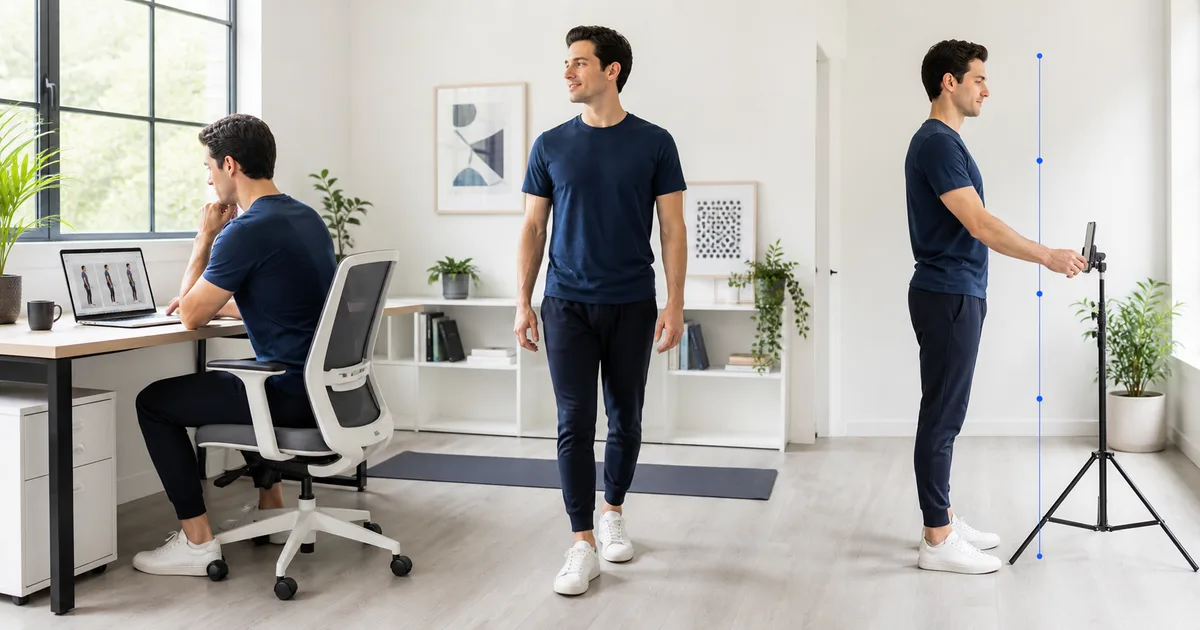
Start with the capture, because a small setup error can change a 2D angle. Check that the camera was level and approximately at hip height, the whole body was visible, you stood naturally rather than “standing tall” for the shot, and the view was truly front-on or side-on. Clothing should reveal the shoulder, waist, hip, and knee lines without requiring bare skin.
If a number surprises you, repeat that view once. Use the same camera, height, distance, lighting, clothing, and relaxed stance. The complete home posture photo protocol explains why a repeatable phone setup is more useful than a mirror or a casual handheld photo.
A repeated flag is still not a diagnosis. It simply makes the visible signal more likely to be real rather than a camera artifact. PosturaScreen marks several measurements as approx because a 2D photo cannot locate every anatomical landmark or reproduce radiographic measurements. The methodology page documents those limits metric by metric.
2. Put the number in symptom and function context
Ask three questions before deciding whether a screen needs any action:
- Do I have pain or other symptoms? A visible pattern can exist with no pain, and pain has many possible drivers.
- Is anything I need to do becoming harder? Walking, lifting, working, sleeping, turning the head, or ordinary daily tasks matter more than a photo grade alone.
- Is this new or changing? A stable personal pattern is different from a sudden change after injury or a trend that keeps progressing.
This caution is supported by the evidence. A systematic review of systematic reviews found no consensus that spinal posture or common physical exposures cause low-back pain; the literature contains both positive and null associations (Swain et al., Journal of Biomechanics, 2020). That does not make posture meaningless. It means a photo should be interpreted as one observation alongside symptoms, function, history, and change over time.
The practical rule is simple: use the screen to notice and track; use symptoms and function to decide whether professional assessment matters.
3. Try a two-minute comfortable movement break
For a symptom-free adult who is able to move normally, a short general movement break is a lower-risk starting point than a body-part-specific “corrective” routine. The aim is not to push a flagged angle back into range. The aim is to leave a sustained position, move several regions comfortably, and find a little more variation.
Try this at an easy pace:
- 40 seconds: walk or march. Walk around the room, march gently in place, or move your feet while seated.
- 40 seconds: move the shoulders and arms. Circle the shoulders slowly or reach the arms forward and back within a comfortable range.
- 40 seconds: turn the head gently. Look left and right within a range that feels easy. Do not pull, bounce, or push into pain.
This is an activity break, not rehabilitation. The CDC’s workplace guide supports short activity breaks, adapting movements to the body, starting with low intensity, and stopping if something hurts (CDC Physical Activity Breaks guide). NHS physiotherapy guidance similarly favors gentle, tolerable movement and changing posture regularly rather than trying to maintain one supposedly “good” posture (Newcastle Hospitals NHS Foundation Trust).
Stop if the movement causes pain, dizziness, disturbed vision, numbness, weakness, balance difficulty, or symptoms that spread into an arm or leg. Those are not signals to push through.
4. Change repeated positions instead of chasing a perfect pose
The most useful posture is usually the next comfortable one. Sitting upright can be fine. Slouching briefly can be fine. Standing can be fine. The problem with any of them is often the word briefly: people settle into one position for a long period and expect a perfectly adjusted chair to make stillness harmless.
Pick one environmental change that makes movement easier:
- Place water, a printer, or a frequently used item far enough away that you stand to reach it.
- Alternate one seated task with one standing or walking task.
- Raise a screen that repeatedly makes you look down, but keep changing position after the adjustment.
- Use phone calls, loading screens, or the end of a meeting as cues to take a short walk.
- Choose a movement you already enjoy and can repeat; adherence matters more than a fashionable correction drill.
WHO guidance recommends limiting sedentary time and replacing it with physical activity of any intensity, including light activity (WHO physical activity and sedentary behaviour guidelines). A workstation adjustment can remove unnecessary friction, but it is not a cure and it does not prove what caused a visible posture pattern. The desk-worker posture guide has a more detailed setup checklist.
5. Retest in 14 days under the same conditions
Two weeks is not a promise that a measurement will change. It is a practical first interval for turning a one-time result into a habit and checking whether your process is repeatable. If you are following a clinician-designed program, use the interval they recommend instead.
On retest day, reproduce the baseline:
- same front or side view;
- same camera and lens;
- same camera height, distance, and level;
- similar lighting and clothing;
- same relaxed stance, without posing;
- similar time of day when practical.
Compare the annotated photos and numbers together. Treat a small one-off difference cautiously; camera setup and natural day-to-day variation can create noise. A directional change that appears across multiple well-matched screens is more useful than a single “better” number.
If you do not want an account, add the 14-day calendar reminder from your temporary result page and repeat the free screen then. If you want side-by-side history, save the result to a free personal account; registration is optional for the one-off screen.
What not to do after a posture screen
- Do not diagnose yourself from a flag. “Outside reference range” means the visible estimate crossed a screening threshold, not that tissue is damaged.
- Do not force a rigid position all day. Holding the shoulders back or the chin tucked for hours simply replaces one sustained posture with another.
- Do not copy a rehab program chosen for someone else’s diagnosis. Exercise can influence postural measurements, but programs in research vary widely and should match the person and goal (González-Gálvez et al., 2024 systematic review).
- Do not retest every day. Daily photos encourage over-reading normal variation and make setup noise look like progress or regression.
- Do not ignore symptoms because a report looks normal. A 2D posture screen cannot rule out an injury or medical condition.
When a clinician or urgent care is the right next step
Book a qualified clinician when pain is persistent, limits normal activity, is getting worse, follows an injury, or comes with spreading pain, recurring numbness, weakness, dizziness, vision changes, or balance problems. A licensed physiotherapist or physician can combine symptoms and history with strength, mobility, neurological, and other physical tests that a photo cannot perform.
Seek urgent medical assessment for severe or rapidly worsening symptoms, significant trauma, new weakness, major walking or balance difficulty, or new bladder or bowel changes. NHS back-pain guidance specifically treats back pain with numbness around the genitals or anus, symptoms in both legs, or bladder or bowel changes as an emergency (NHS back pain guidance). Follow the emergency guidance where you live.
Frequently asked questions
What should I do after a posture screening?
Verify the photo first, treat flags as screening signals rather than diagnoses, use symptoms and function as context, move comfortably, and repeat the same photo setup in about two weeks. A trend across matched photos is more useful than one isolated result.
Can a posture photo tell me which exercises I need?
No. A photo cannot test pain, strength, mobility, tissue health, medical history, or why a pattern appears. Those factors are needed to choose individual rehabilitation. A general movement break can be useful for many symptom-free adults, but it is not a treatment selected from your measurements.
Is there one perfect posture I should hold?
No single position needs to be held all day. Regular posture changes and comfortable movement are more useful than forcing one rigid shape. Think “more positions” rather than “perfect position.”
How often should I repeat a posture photo?
Fourteen days is a practical first reminder for habit tracking, but the exact interval matters less than a consistent setup. Longer exercise or clinical programs may use several weeks. Use the same camera height, distance, lighting, clothing, view, and relaxed stance each time.
When should posture symptoms be checked by a clinician?
Seek professional advice for persistent, severe, rapidly worsening, or post-injury pain, or symptoms such as numbness, weakness, dizziness, vision changes, spreading pain, or balance problems. Back pain with bladder or bowel changes or numbness around the genitals or anus needs urgent assessment.
This article provides general posture education and a low-intensity activity-break example. It does not diagnose a condition, prescribe rehabilitation, or replace individual medical advice. Stop any movement that causes concerning symptoms and consult a qualified healthcare professional when needed. See our editorial standards for how sources are selected and content is reviewed.
Free posture screening, in seconds.
Start with one photo. Add the second for all 17 metrics. No account or app required.
Start a free posture screen