Swayback Posture: What It Is and What It Looks Like
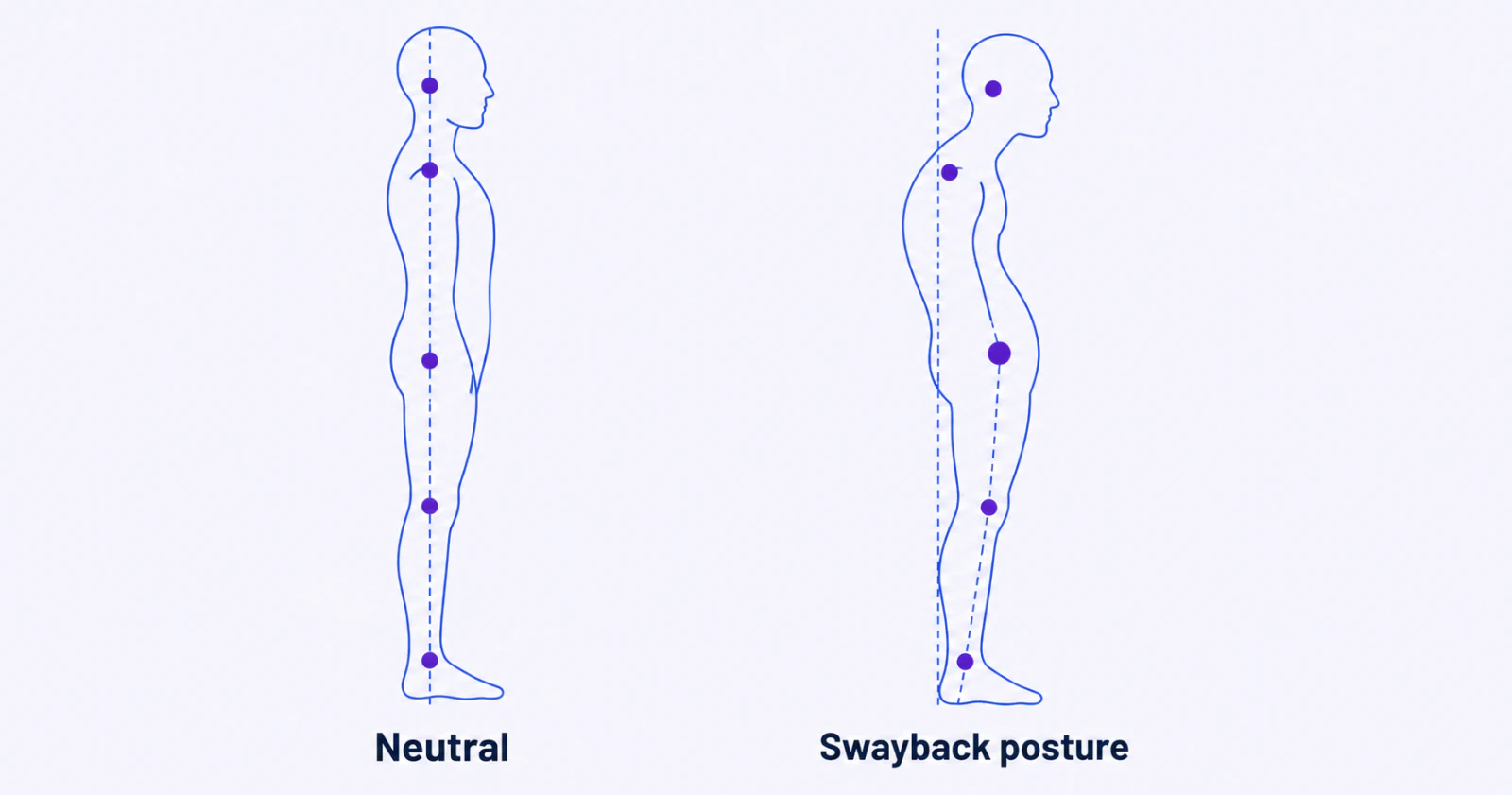
Swayback posture is a standing pattern in which the hips sit forward of the ankles with the pelvis tilted back, while the upper body leans back behind the hips, so the body seems to hang on its hips. That is the clinical meaning, from Kendall’s posture classification. In everyday speech, “swayback” often means a deep lower-back arch instead, which is closer to anterior pelvic tilt: the pelvis tips the opposite way. A side photo shows which one you are looking at.
Meaning 1: the everyday “swayback” — a deep lower-back arch
When most people say “swayback,” they mean an exaggerated lower-back curve. The lower spine hollows inward more than usual, the buttocks project backward, and from the side the lumbar region shows a pronounced arch. In this sense, “swayback” is a lay word for hyperlordosis, and it usually travels with an anterior pelvic tilt, where the front of the pelvis drops and the lower back deepens its curve.
If this is the pattern you are picturing, the guide to lumbar lordosis covers how much lower-back curve is normal, and the anterior pelvic tilt guide covers the pelvic rotation that goes with it. The clinical swayback posture below is a different pattern that shares the name.
Meaning 2: the clinical swayback posture — hips forward, trunk back
Kendall’s classification describes swayback as a posture with “a posterior displacement (swaying back) of the upper trunk and an anterior displacement (swaying forward) of the pelvis”, with the pelvis in posterior tilt, as quoted by Lewis and Sahrmann (2015). A 2018 review of sagittal posture types by Czaprowski and colleagues fills in the rest of the body. Reading from the ground up:
- The pelvis shifts forward. The whole pelvis sits ahead of the ankles, so the hips lead the body. This is the pattern’s most recognizable feature.
- The pelvis tilts back compared with neutral. Kendall describes a posterior pelvic tilt; Czaprowski and colleagues describe a normal or slightly reduced forward tilt. Either way, it is the opposite of the deep-arch pattern.
- The hips and knees extend. The hip joints are extended, and the knees are neutral or pushed back (hyperextended).
- The lower-back curve looks shorter. The upper-back curve extends down into the upper lumbar spine, which flattens, while the lowest part of the lower back can arch more.
- The upper trunk leans back. The chest sits behind the hips, producing the characteristic “sway”.
- The upper back rounds and the head sits forward. A long thoracic kyphosis develops, and forward head posture commonly tops off the pattern.
The net impression in a side photo is a body leaning back over forward-shifted hips, with a long, gentle curve rather than one sharp arch. In the Lewis and Sahrmann gait study, volunteers who walked in the posture were told it would feel like “leading with the hips”.
The two meanings side by side
| "Swayback" = deep archEveryday use | "Swayback posture" = hips forwardClinical | |
|---|---|---|
| What it refers to | An exaggerated lower-back arch | A whole-body hips-forward pattern |
| Pelvic tilt | Anterior (forward) tilt | Backward compared with neutral, plus a forward shift |
| Lower back | Deep arch (hyperlordosis) | Shorter curve: upper lumbar flattened, lowest part may arch |
| Upper body | Roughly upright | Leans back behind the hips |
| Closest guide | Anterior pelvic tilt / lumbar lordosis | Posterior pelvic tilt |
Neither pattern is a diagnosis. Both describe where a body sits among common standing postures. Separating them matters because advice written for one does not fit the other.
What’s behind the swayback pattern, and what tends to be tight or long
Czaprowski and colleagues classify swayback as a non-structural misalignment: a way of standing, photographed in their examples in each person’s habitual stance, rather than a fixed change in the bones. In practice it looks like a relaxed stance that pushes the pelvis forward and lets the upper body sink back over it, which is why it is sometimes called a “lazy” or “collapsed” stance.
The same 2018 review lists which muscles tend to sit in a lengthened or shortened position in this posture:
- Tending to be lengthened: the one-joint hip flexors at the front of the hip (iliacus and psoas) and two-joint hip flexors, the lower abdominal fibres, the back extensors of the upper back and upper lumbar spine, and the muscles that hold the shoulder blades.
- Tending to be shortened: the hamstrings, the upper abdominal fibres, the gluteus maximus, the lowest part of the lower-back extensors, the chest muscles, and the muscles at the front and back of the neck that hold the head forward.
Two cautions matter. “Short” and “weak” are not interchangeable: a muscle can be short without being strong, or long without being weak. And these are pattern-level descriptions, not a map of any one person; an examination can find something different.
General movement ideas, not a prescription
Varying your standing position through the day, rather than living in one hips-forward stance, and noticing where your hips sit relative to your shoulders are reasonable general habits. Which stretches or strengthening work would help, and how much, depends on what an examination finds, and that is the territory of a licensed physiotherapist or physician rather than an article.
What swayback looks like in a side photo
The clearest sign is where the hips sit relative to the shoulders and ankles. Take a side photo with the camera at hip height and level, standing far enough back that your body fills about two-thirds of the frame height: roughly 2 m on the 1× lens or 3 m on 2× (our estimate). The posture photo guide covers the setup.
Then compare the photo with a vertical line, as in the plumb line posture test, which runs from the ear canal through the shoulder to just in front of the ankle. In swayback, the hips sit clearly ahead of that line while the shoulders sit behind it, so the body appears to lean back over forward hips. Czaprowski and colleagues describe the same thing: the pelvis is in front of the line and the upper trunk behind it. In the deep-arch pattern, by contrast, the hips and shoulders stay roughly stacked while the lower back hollows sharply and the buttocks project.
The secondary signs reinforce it: a lower-back curve that looks short rather than deep, a long rounded upper back, and a head forward of the shoulders. Clothing, body shape, breathing and the moment of capture all affect these surface signs, so a photo shows the appearance of the posture, not a measurement of the skeleton.
How PosturaScreen sees the components of swayback
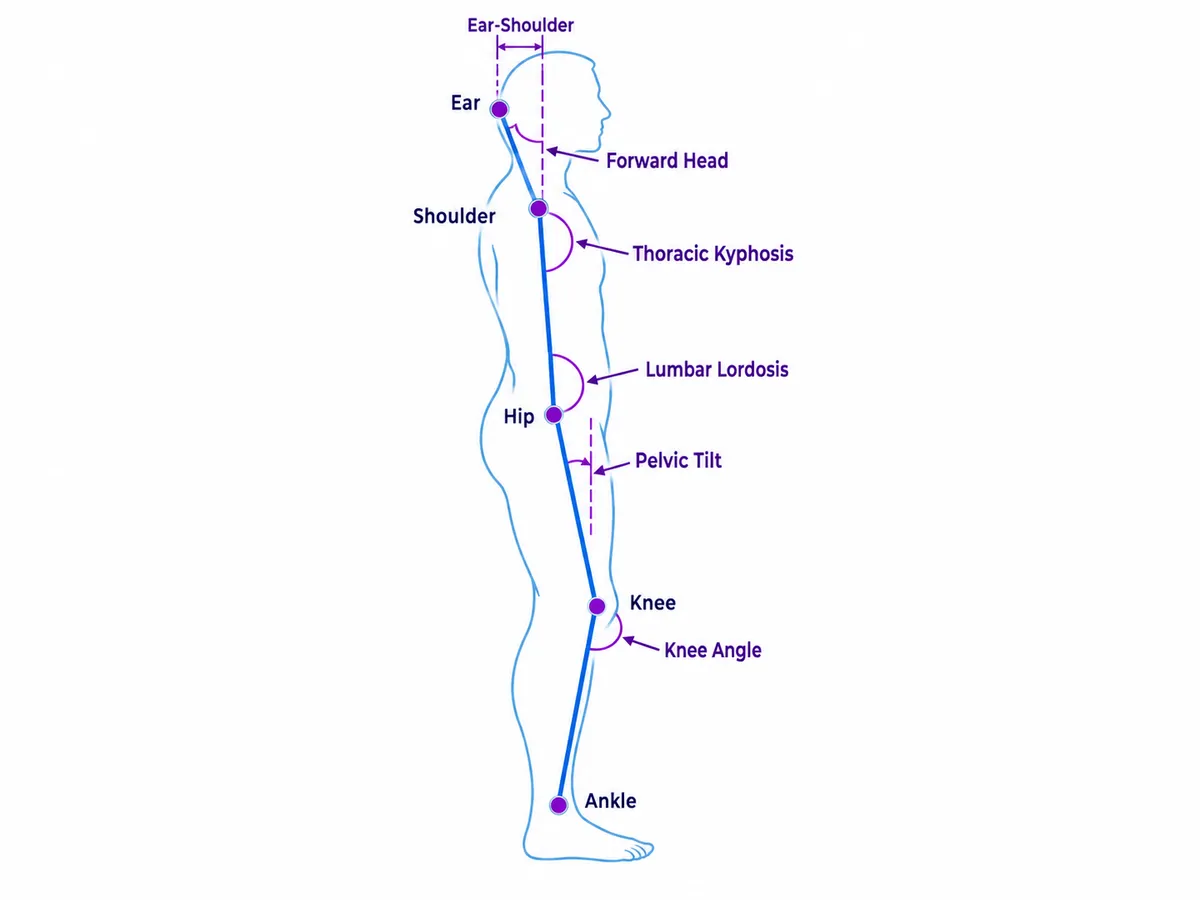
PosturaScreen, the product behind this article, does not output a “swayback score”. From a side photo it reports six metrics, and several of them pick up parts of the pattern:
- Pelvic Tilt (
approx) is the angle of the hip-to-knee line from vertical. In a hips-forward stance the thigh slants, so the value rises. It has no direction, so it reads the same for a forward or backward slant and cannot tell anterior from posterior pelvic tilt. The photo shows which way it goes. - Thoracic Kyphosis (
approx) reflects the bend at the shoulder between the ear and the hip, which a backward-leaning trunk and a forward head both change. - Forward Head (
approx) and Ear-Shoulder capture the head position on top of the pattern. - Knee Angle shows whether the knee is straight; a value below 180° can mean a bent knee or one pushed back, so again the photo shows which.
Reading the numbers together with the photo is what reconstructs the swayback picture. The practical value is tracking the same person under the same camera setup, rather than a one-time grade. The sample report shows a complete readout, and the methodology page gives every formula. Practitioners can run the same side-photo screening as an intake step with posture screening software for clinics.
When to talk to a clinician about swayback posture
A swayback pattern in a side photo, in either sense of the word, does not need a clinical visit on its own. It becomes worth a licensed physiotherapist’s, physician’s or chiropractor’s attention when it comes with any of the following:
- Persistent back, hip, or neck pain that does not settle or that recurs with activity. Lewis and Sahrmann note that they see patients with pain at the front of the hip who stand and walk in a swayback posture.
- Movement limitations, such as difficulty standing for normal periods or walking comfortably.
- A recent change, such as a swayback pattern that was not there before, especially after an injury, pregnancy, or a big change in activity.
- Neurological symptoms: numbness, weakness, or radiating pain, which warrant evaluation regardless of posture.
The OrthoInfo guide to low back pain from the American Academy of Orthopaedic Surgeons describes when back pain warrants a doctor’s evaluation. PosturaScreen is a screening and tracking tool, not a diagnostic device, and a photo cannot decide whether a posture is causing a problem.
This article was prepared by the PosturaScreen editorial team for posture education. It is not medical advice and is not a substitute for a clinical evaluation. PosturaScreen is a screening and tracking tool, not a diagnostic device. If you have concerns about your posture or musculoskeletal health, consult a licensed healthcare professional. See our editorial standards for how this article was written and reviewed.
Free posture screening, in seconds.
Start with one photo. Add the second for all 17 metrics. No account or app required.
Start a free posture screen