Anterior Pelvic Tilt: What It Looks Like in 2D Photos
Anterior pelvic tilt (APT) is a rotation where the front of the pelvis drops and the back rises. From the side, the clearest surface cue is a waistline that slopes down toward the front. A deeper lower-back curve, backward-projecting buttocks, and a forward-looking abdomen can accompany it, but body shape and clothing affect those contours. APT does not by itself mean the hips have shifted ahead of the shoulders; that translation is a different whole-body pattern. This guide explains what APT looks like in 2D photos, how to take a repeatable side view, and what a photo cannot confirm.
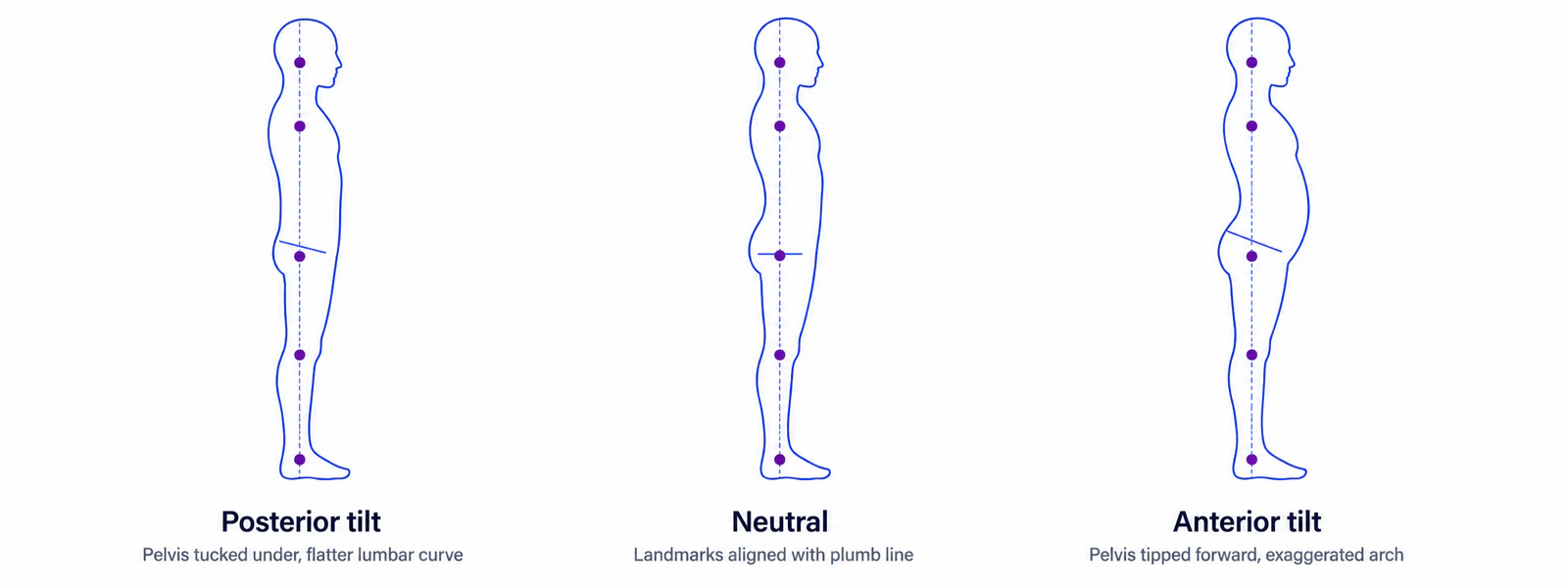
- APT = front of the pelvis drops, back rises → a forward-tilted waistline, often with a deeper lower-back contour.
- Most visible from the side view of a clean full-body photo, with the camera level at hip height and the body filling about two-thirds of the frame height.
- APT is a postural pattern, not a diagnosis. It is relatively common and often asymptomatic, but it should be interpreted together with the full clinical picture.
- A 2D photo lets a person track changes in pelvic position over weeks or months — that is the strongest use case, not a one-time grade.
- A strong APT signal combined with persistent pain, stiffness, or movement limitations is worth discussing with a licensed physiotherapist, physician, or chiropractor.
What anterior pelvic tilt is
Anterior pelvic tilt (APT) describes a postural pattern where the front of the pelvis drops and the back of the pelvis rises. Viewed from the side, the pelvis rotates as a unit so the top of the iliac crests tilts forward and downward, while the back tilts upward. This rotation often accompanies a more pronounced curve in the lower back — what clinicians call lumbar lordosis — but it does not require the hips to translate forward relative to the shoulders.
Some readers will encounter the same rotation under names such as anterior hip tilt or a generic tilted pelvis. Anterior pelvic shift can instead describe the whole pelvis translating forward, so it should not be treated as a synonym for tilt. In clinical contexts, pelvic obliquity typically refers to a side-to-side hip-height difference rather than the front-to-back rotation that defines APT.
The opposite pattern, posterior pelvic tilt (PPT), happens when the top of the pelvis rotates backward. The lower-back curve flattens, the hips appear tucked under, and the buttocks sit lower and tighter. A neutral pelvic position sits between the two extremes, with the lower back showing a normal lordotic curve but without the exaggerated arch of APT or the flatness of PPT.
A few framing notes matter here. APT is a postural pattern, not a diagnosis. The phrase appears in physiotherapy literature, athletic-training material, and consumer health content because the visible signs are easy to identify — not because every visible APT is medically significant. The Cleveland Clinic, for example, describes pelvic tilt as a description of pelvic position relative to neutral, separate from any judgment about whether it requires intervention.
Throughout this article, the focus stays on what APT looks like in a 2D side photo and how to interpret what you see. PosturaScreen, the product behind this blog, estimates a pelvic tilt angle from photo landmarks and tags it approx; that angle shows the size of the tilt signal, not whether it is anterior or posterior. The reasoning behind that tag is covered in the section on how PosturaScreen estimates pelvic tilt from photos.
How common it is
A casual look around any gym, office, or family gathering reveals an obvious truth: pelvic tilt sits on a spectrum, and the exact neutral pelvis is statistically rare. A review in the International Journal of Sports Physical Therapy examined clinical measures of pelvic tilt and reported wide variation across healthy adult populations, with most people falling somewhere on a small bias toward anterior or posterior tilt rather than landing on a textbook-neutral position.
That observation matters for how to read a photograph. Seeing a few degrees of forward pelvic rotation in a side photo does not, on its own, mean anything is wrong. This is a relatively common finding and is often asymptomatic, but it should be interpreted together with the full clinical picture. A person with a visible APT signal and no pain, no movement limitations, and no functional concerns is statistically closer to the norm than to an outlier.
Where APT becomes more meaningful is when several cues agree — a clearly forward-sloping waistline with a deeper lower-back contour and projecting buttocks, while the hips and shoulders remain roughly stacked — AND the pattern co-occurs with persistent low-back pain or movement restrictions. In those situations the photo serves as one data point in a broader conversation, never the diagnosis itself.
Several factors are commonly associated with APT in observational studies: prolonged sitting, hip-flexor tightness, and certain athletic loading patterns. Whether any of these cause APT in any given person is a research question that goes beyond a postural photograph. For most practical purposes, the right mindset is: common postural pattern, sometimes worth a closer clinical look, often worth nothing more than noticing.
What APT looks like in 2D photos
The most useful place to look for anterior pelvic tilt is a side-view photograph taken at roughly hip height, with the whole body in frame and a clean background behind the subject. From that angle, four surface cues can appear together. None confirms the true bony pelvic angle on its own.
The first and most direct surface cue is the waistline angle. If the subject is wearing pants or shorts with a defined waistband, the band slopes forward and downward at the front rather than running horizontal to the floor. In a side photo, the front of the belt or waistband sits lower than the back. This is a clothing-level proxy for pelvic orientation, not a skeletal measurement.
The second cue is a deeper lower-back contour. In a neutral side view, the lower spine shows a gentle inward curve — the natural lumbar lordosis. With APT, that surface curve often looks more pronounced and the hollow above the buttocks may look deeper. Pelvic tilt and lumbar curve are related but not interchangeable, so the curve supports the pattern rather than proving it.
The third cue is the posterior pelvic contour. As the pelvis rotates forward, the buttocks may project farther backward even while the hip joint remains roughly stacked under the shoulder. If the hips themselves sit clearly ahead of the shoulders and the trunk leans back, that is forward translation — a defining feature of clinical swayback posture — not evidence of anterior tilt by itself.
The fourth cue is a forward-looking abdomen, which can accompany the rotated pelvis but is highly variable. Clothing, body composition, breathing, and abdominal muscle activity all change this contour. It should never be used as a standalone sign or interpreted as a statement about body fat.
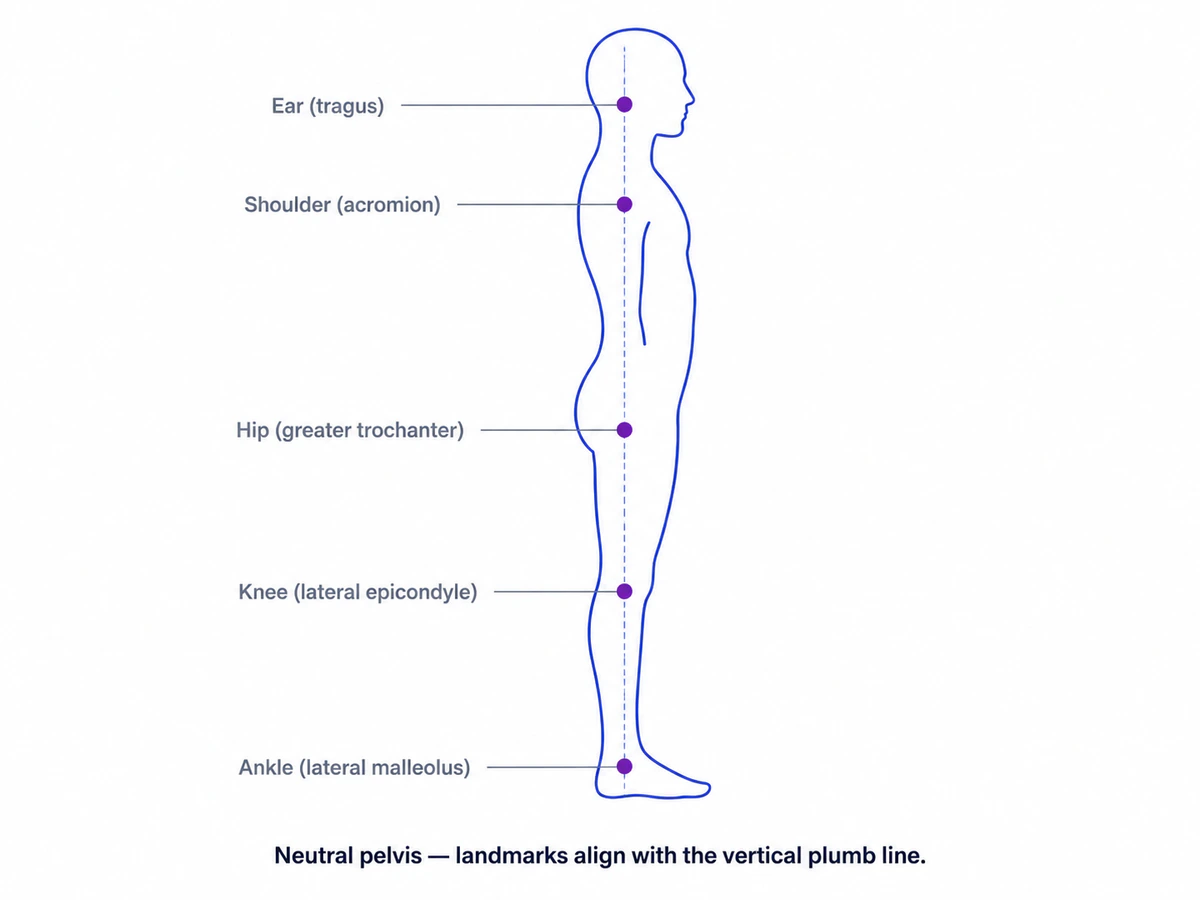
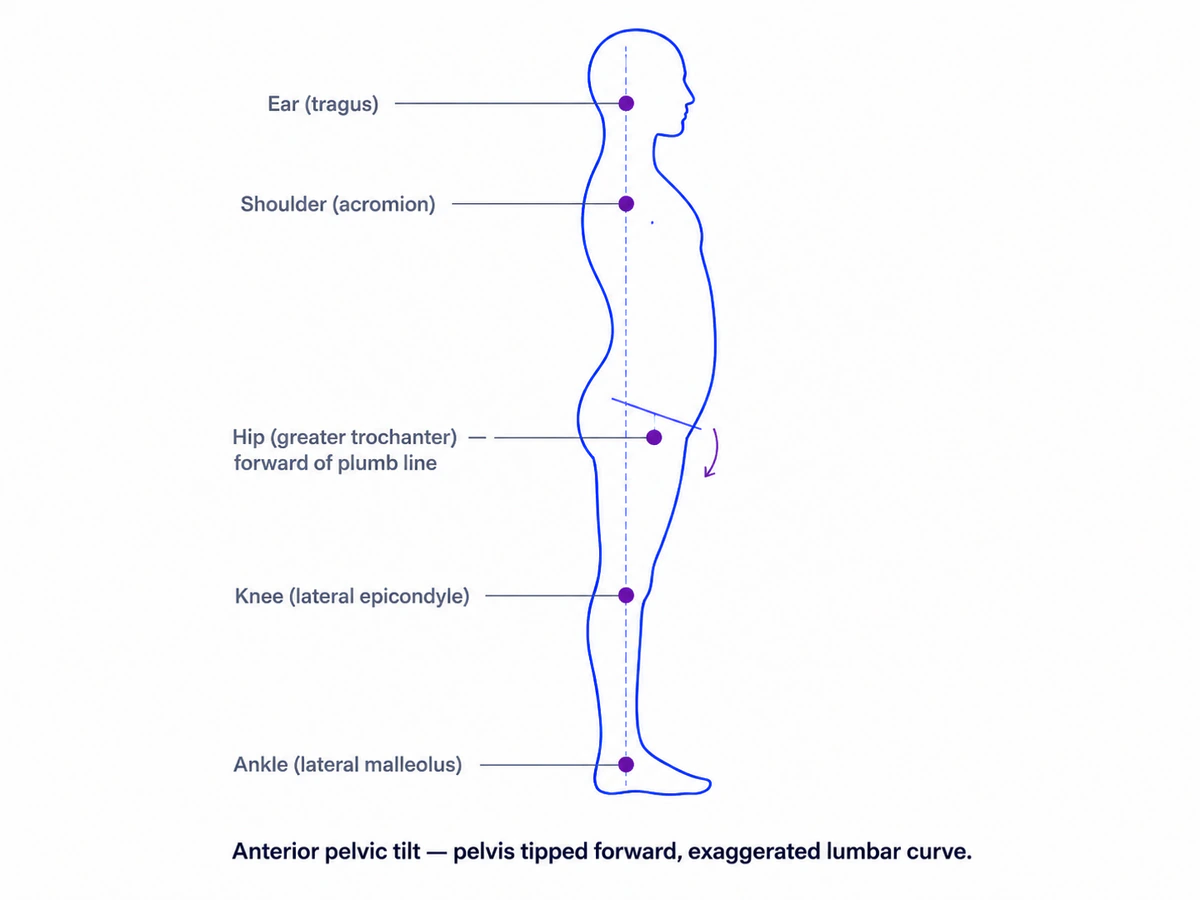
Several common photo conditions distort or hide these signs. A camera held above hip height makes the pelvis look more tilted than it is; a camera below hip height flattens the curve. Loose drape-style clothing hides the waistline angle entirely. Photos taken from a slight three-quarter angle rather than a true side view make the comparison to a plumb line for side-view alignment unreliable. The next section on capture protocol covers how to avoid these errors.
It is worth emphasizing what these visual signs are not. They are surface-contour patterns that suggest the underlying pelvic rotation, not a measurement of any skeletal angle. The visual signal is genuinely useful, especially for trending over time in the same person under the same conditions — but it is a screening signal, not a diagnostic measurement.
Across the four cues, the waistline or visible pelvic angle is the most direct surface indicator. The lower-back, buttock, and abdominal contours are supporting clues with more individual variation. Even when several cues agree, a photo shows an external pattern rather than the true bony pelvic angle.
APT vs PPT — at a glance
Anterior pelvic tilt is one end of a small spectrum. The other end is posterior pelvic tilt (PPT), where the pelvis rotates backward, the lower back flattens, and the hips tuck under. A neutral pelvis sits in between, with a normal but not exaggerated lower-back curve.
Most people in everyday photographs do not show a pure example of any one pattern. A small bias toward APT or toward PPT is the norm. Pure APT or pure PPT — extreme rotation in either direction — is uncommon in healthy adults outside of athletic, occupational, or post-injury contexts. The summary below (adapted from Ivy Rehab’s clinical breakdown) is meant for orientation: actual photos rarely fit any single column perfectly, and small mixes are common.
| Posterior pelvic tiltTipped back | NeutralAligned | Anterior pelvic tiltTipped forward | |
|---|---|---|---|
| Pelvic rotation | Tipped backward | Neutral | Tipped forward |
| Waistline cue | Front may sit higher | Roughly level | Front may sit lower |
| Buttocks appearance | May look tucked | Neutral | May project backward |
| Lumbar curve | Often flatter | Neutral lordosis | Often deeper |
The takeaway: knowing where someone sits on this spectrum is more useful than placing them in a category. A person whose photo signals “slightly anterior” is not in the same situation as someone whose photo signals “strongly anterior with pain and stiffness.”
How to take a side photo to see your own pelvic tilt
A photograph that reliably reveals pelvic tilt follows the complete at-home posture photo guide. Most distortion comes from the camera, not from the body — small changes in camera height, angle, or distance can make the same person look more or less tilted than they actually are.
The protocol is straightforward:
- Background. Stand against a plain wall or a flat surface free of clutter. Avoid backgrounds with horizontal lines that compete visually with the waistline.
- Body position. Stand sideways to the camera, weight evenly distributed on both feet, arms relaxed at the sides. Avoid pressing the arms against the hips or putting hands in pockets. Look straight ahead, not down or up.
- Camera position. The camera should sit at approximately hip height, not above or below. A tripod or a stack of books works. A phone propped against something stable is fine.
- Camera distance. Stand far enough back that your body fills about two-thirds of the frame height: roughly 2 m on the 1× lens or 3 m on 2×, our estimate. Closer than that introduces lens distortion that exaggerates whichever body part is closest to the camera. How to take posture photos covers this setup in more detail.
- Framing. The whole body should be in the frame, with the hip approximately in the vertical center of the photo. Heads cut off, feet cut off, or hips off-center will make later comparisons unreliable.
- Camera level. Use a phone’s built-in level indicator or a level app. A tilted camera makes every angle in the photo unreliable.
- Clothing. Close-fitting, athletic, or undergarments work best. Loose drape clothing hides the waistline angle and the lower-back curve. The goal is to see body contours, not fabric drape.
- Pose. Stand naturally. “Performing good posture” defeats the point of the photograph. Stand the way you stand when you are not thinking about it.
Two side photos — one of each side — give a more complete picture than a single side. Some people have a small asymmetry that shows up on one side but not the other. Taking both sides also helps catch capture errors: a single mis-leveled photo will look very different from the matching side taken correctly.
For self-screening, taking the same set of photos every few weeks under the same conditions is more informative than a single grade. The PosturaScreen sample report shows what a clinical report based on this kind of capture looks like, and the methodology page documents how each metric is computed from the keypoints in the photo.
Three common mistakes account for most “my photo looks weird” results: (1) the camera was held by another person at chest height instead of being mounted at hip height; (2) the subject was wearing baggy or wrinkled clothing; (3) the subject “fixed” their posture before the photo was taken. Re-shooting under controlled conditions usually resolves these.
How PosturaScreen estimates pelvic tilt from photos
PosturaScreen, the product behind this article, estimates a sagittal pelvic tilt signal from a single side-view photo. The calculation is deterministic and geometric: a vector is drawn from the hip keypoint to the knee keypoint, and the angle between that vector and a vertical reference line is reported as an approximate pelvic tilt angle, in degrees. The angle is unsigned: it shows how far the thigh line leans from vertical, not which way, so the number on its own cannot tell anterior from posterior pelvic tilt. The direction comes from the visual signs described above. The system does not measure the true pelvic bone angle; it estimates a 2D posture signal from visible surface landmarks.
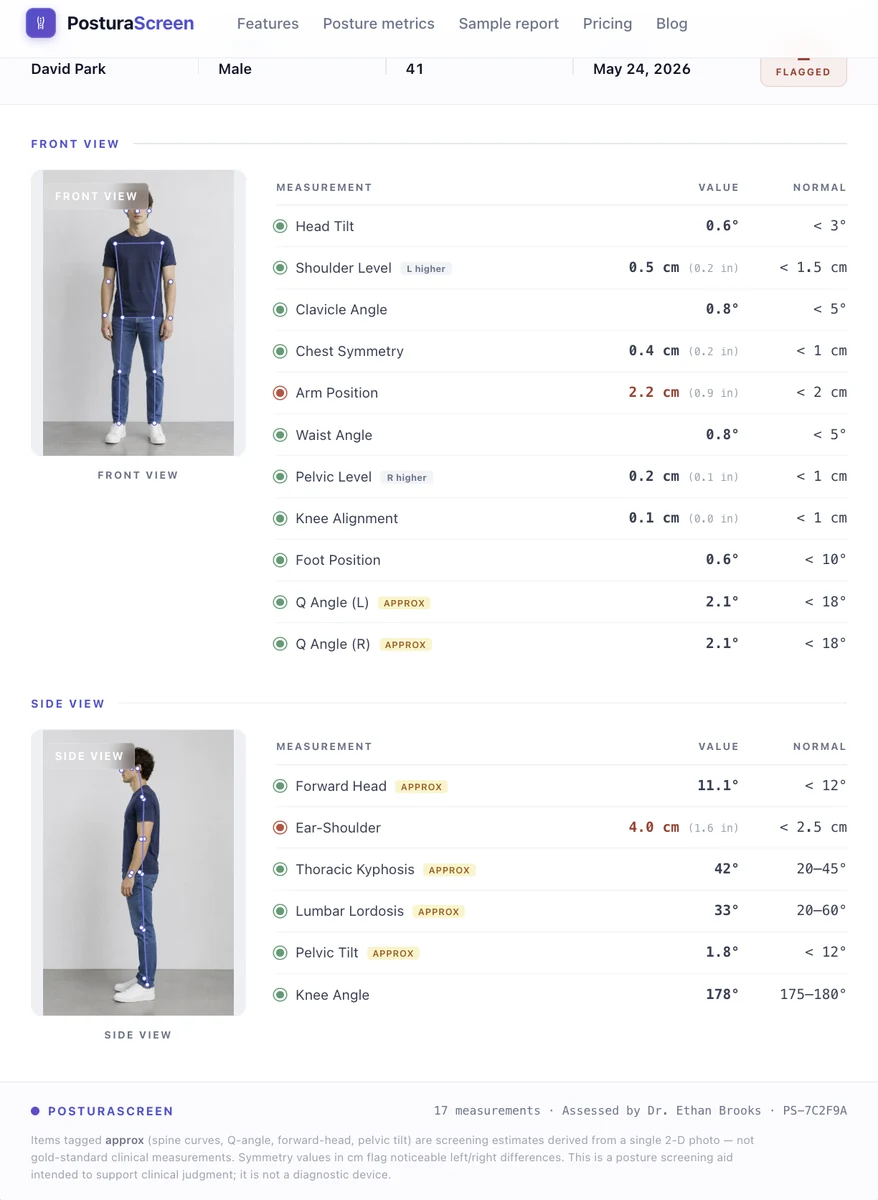
approx because 2D photo measurements differ from radiographic ones.In every report, this metric carries an approx tag. The tag is honest about what the number represents. The geometric calculation reliably captures the surface relationship between the hip and the leg in the photo. It does not capture the underlying skeletal pelvic tilt the way a radiograph would, because surface contour is influenced by clothing, body composition, breathing phase, and small variations in how the subject was standing at the moment of capture. The reading is best used to compare the same person over time under similar photo conditions, not to grade absolute clinical severity between individuals.
The practical value of this number is not absolute clinical grading. The practical value is trending in the same person under consistent capture conditions. A pelvic tilt reading of 8 degrees today is not directly comparable to someone else’s 8 degrees taken under different conditions, but it is comparable to that same person’s 6 degrees six weeks later, if both photos were taken with the same setup.
That is how PosturaScreen tends to be used in practice: as a screening signal that initiates a conversation, and as a tracking signal that flags change over time. This is also why clinics that adopt posture-screening software for clinics treat the pelvic tilt reading as a starting point for examination rather than a standalone verdict. The full mathematical definition of every metric, including pelvic tilt, lives on the PosturaScreen methodology page. The 17 posture metrics that go into a standard report, including pelvic tilt, are documented there as well.
When to talk to a clinician about anterior pelvic tilt
A side photo with a visible APT signal does not require a clinical visit on its own. As noted earlier, some degree of pelvic tilt is the norm. A visible APT pattern in a photo can appear in people with or without symptoms; by itself, the photo finding does not prove the posture is painful, harmful, or clinically significant.
The signal becomes worth a clinician’s attention when it co-occurs with one or more of the following:
- Persistent low-back, hip, or knee pain that does not resolve with simple rest or that recurs with activity.
- Movement limitations — difficulty walking comfortably, running without discomfort, squatting through a full range of motion, or sitting for normal periods.
- Recent change — a visible APT signal that was not previously present, especially after an injury, pregnancy, or significant change in activity level.
- Postural concerns paired with neurological symptoms — any numbness, weakness, or radiating pain. These warrant clinical evaluation independent of the APT signal.
Several professional groups are positioned to integrate a photo signal with the rest of someone’s clinical picture: licensed physiotherapists, chiropractors, sports-medicine physicians, and orthopedic specialists. They can perform a physical examination, take a history, and decide whether the postural pattern observed in a photograph is worth further investigation, treatment, or simply monitoring over time. The OrthoInfo guide to low back pain from the American Academy of Orthopaedic Surgeons describes when back pain warrants a doctor’s evaluation.
What a photograph cannot do is replace any of that. A photograph is a snapshot of surface contour at a moment in time. It does not measure pain. It does not measure strength. It does not measure tissue health. It does not capture the dozens of other things a clinician integrates into an assessment.
PosturaScreen is built as a screening and tracking tool. It is not a diagnostic device, and it does not provide medical advice. The information in this article is educational. For specific concerns about posture or musculoskeletal health, the right next step is a conversation with a qualified healthcare professional.
Frequently asked questions
What does anterior pelvic tilt look like?
From the side, anterior pelvic tilt can show as a waistband that slopes down toward the front, a deeper lower-back curve, buttocks that project backward, and sometimes a forward-looking abdomen. The waistband or pelvic angle is the most direct surface cue. Hips clearly ahead of the shoulders suggest a separate forward translation, such as swayback, rather than pelvic tilt alone.
How can someone tell if they have anterior pelvic tilt?
Stand naturally side-on against a clean wall and take a full-body photo with the camera at hip height. Look first at whether the waistband sits lower in front than at the back. A deeper lumbar curve and projecting buttocks can support that impression, but body shape and clothing affect both. A photo can screen the visible pattern; it cannot confirm the true bony pelvic angle.
Is anterior pelvic tilt bad?
Anterior pelvic tilt is a postural pattern, not a diagnosis. This is a relatively common finding and is often asymptomatic, but it should be interpreted together with the full clinical picture. APT becomes worth clinical attention when it occurs alongside pain, stiffness, or movement restrictions. A photograph alone cannot determine whether anyone’s APT is medically significant — that judgment belongs to a clinician.
What’s the difference between anterior and posterior pelvic tilt?
Anterior pelvic tilt means the pelvis rotates forward; the waistline slopes down toward the front, the lower-back curve may deepen, and the buttocks may project. Posterior pelvic tilt means the pelvis rotates backward; the front of the waistline rises, the lower back may flatten, and the buttocks may tuck. Neither tilt alone requires the hips to shift ahead of or behind the shoulders.
Can a 2D photo really measure pelvic tilt?
A 2D side photo reliably shows the appearance of pelvic tilt. It does not measure the underlying skeletal pelvic tilt the way a radiograph does, because surface contour is influenced by clothing, body composition, and breathing phase. Photo-based pelvic tilt readings are best used for tracking change in the same person over time, not for comparing absolute numbers between people. That is why PosturaScreen tags this metric approx in every report.
When should someone see a clinician about anterior pelvic tilt?
When a visible APT signal in side photos occurs alongside ongoing pain, stiffness, or movement limitations in the lower back, hips, or knees, it is worth consulting a licensed physiotherapist, physician, or chiropractor. They can integrate the photo signal with a physical examination and history to decide if anything needs intervention. PosturaScreen is a screening and tracking tool, not a diagnostic device.
This article was prepared by the PosturaScreen editorial team for posture education. It is not medical advice and is not a substitute for a clinical evaluation. PosturaScreen is a screening and tracking tool, not a diagnostic device. If you have concerns about your posture or musculoskeletal health, consult a licensed healthcare professional. See our editorial standards for how this article was written and reviewed.
Free posture screening, in seconds.
Start with one photo. Add the second for all 17 metrics. No account or app required.
Start a free posture screen