Lumbar Lordosis: What the Lower-Back Curve Looks Like
Lumbar lordosis is the natural inward curve of the lower spine — the gentle hollow you can see above the buttocks in a side-view photo. Everyone has some; it is a normal feature of the human spine, not a problem in itself. What varies from person to person is the depth of that curve: a typical curve, an exaggerated one (hyperlordosis), or a flattened one (hypolordosis). The depth of the lumbar curve is a postural description, not a diagnosis, and it should be interpreted together with the full clinical picture. This guide explains what lumbar lordosis looks like in 2D photos, how the curve connects to pelvic tilt, how to take a usable side view, and when the photo signs are worth discussing with a clinician.
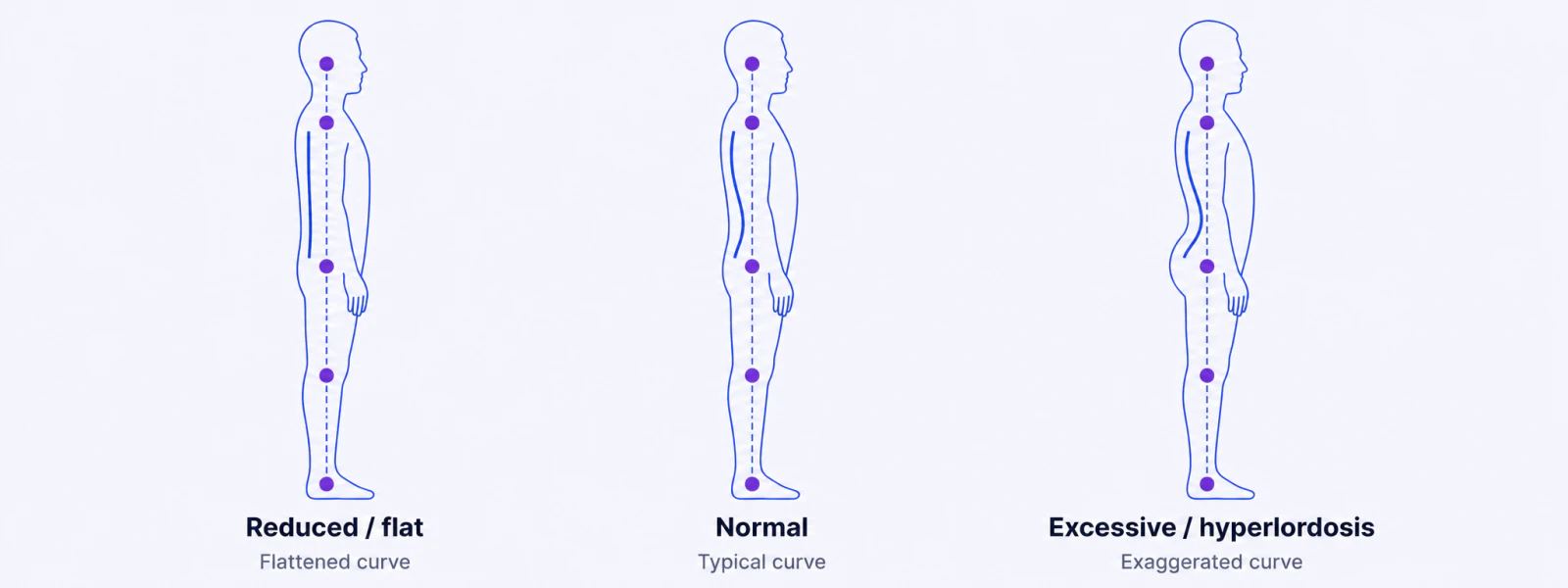
- Lumbar lordosis = the normal inward curve of the lower back. Everyone has one; only the depth varies.
- A deep curve is hyperlordosis (“swayback” look); a flat curve is hypolordosis (“flat back” look). Both are descriptions, not diagnoses.
- The lumbar curve tracks with pelvic position: anterior pelvic tilt deepens it, posterior pelvic tilt flattens it.
- Most visible from the side view of a clean full-body photo, with the camera level at hip height and the body filling about two-thirds of the frame height.
- A strongly flattened or exaggerated curve combined with persistent pain, stiffness, or a recent change in a child or teen is worth discussing with a licensed clinician.
Lumbar lordosis meaning: the normal inward lower-back curve
In plain English, lumbar lordosis means the normal inward curve of the lower back. It is the curve of the five lumbar vertebrae between the ribcage and the pelvis. Viewed from the side, a healthy lumbar spine curves gently toward the front of the body, creating the small hollow most people can feel in their lower back. This curve is normal and necessary: it helps the spine absorb load, balance the upper body over the pelvis, and keep the head positioned over the hips, along the side-view line described in plumb line posture.
Because the curve is normal, the word lordosis by itself does not describe a problem — everyone has lumbar lordosis, and the clinically meaningful question is about degree. A curve within the typical range is simply normal lordosis; one much deeper than typical is hyperlordosis, colloquially “swayback”; and one much shallower — a lower back that looks unusually straight — is hypolordosis, informally “flat back.”
The same anatomy appears under related terms: lumbosacral lordosis is the same lower-spine curve, emphasizing the junction where the lumbar spine meets the sacrum, and loss of lumbar lordosis is the radiology phrasing for a flattened curve.
It also helps to place lordosis next to its opposite, kyphosis: lordosis is an inward curve (lower back and neck), kyphosis an outward one (the upper back’s thoracic kyphosis). A healthy spine alternates between these, all normal in moderation — the companion guide on the 17 posture metrics covers how each is described in a report.
One framing note echoes every article in this series: the depth of the lumbar curve is a postural description, not a diagnosis — the Cleveland Clinic notes that most lordosis is not severe enough to cause symptoms or require treatment. Throughout, the focus stays on what the curve looks like in a 2D side photo and how to read it.
How much lumbar curve is normal
There is no single “correct” lumbar curve. Healthy adults show a wide range — radiographic studies measuring the lumbar curve as a Cobb angle report typical values spanning roughly 20 to 60 degrees, with meaningful variation by age, sex, and population. That width is the point: two people with visibly different lower backs can both be entirely normal, and a curve that looks a little deep or a little flat in a photo is usually still within the normal envelope.
That matters for how to read a photograph. A moderately deep or shallow lumbar curve in a side photo does not, on its own, mean anything is wrong. This is a common finding and is often asymptomatic, but it should be interpreted together with the full clinical picture. A slightly exaggerated curve with no pain, no movement limitations, and no functional concerns is statistically closer to the norm than to an outlier.
The curve becomes more meaningful when it is strongly outside the typical range — a clearly deep arch or a clearly flattened lower back — and co-occurs with persistent pain, stiffness, or movement restrictions, or when it changes noticeably in a growing child or teenager. Even then, the photo is one data point in a broader conversation — never the diagnosis itself. For most practical purposes, the right mindset is normal curve with wide variation, sometimes worth a closer clinical look. (A later section maps the factors commonly associated with a deeper or flatter curve, and what clinicians do about it.)
What lumbar lordosis looks like in 2D photos
The lumbar curve reads most reliably in a side-view photograph at roughly hip height (the capture section below covers the setup), where it appears as the contour of the lower back between the ribcage and the top of the buttocks. Three patterns are worth recognizing.
A normal lumbar curve shows a gentle, smooth inward sweep: the hollow is present but not dramatic, and the line from shoulders to hips looks balanced. Hyperlordosis — an exaggerated curve — shows a deeper, sharper hollow, with the buttocks projecting backward and the abdomen appearing to tilt forward (the “swayback” look). Hypolordosis — a reduced curve — shows a flattened lower back: the hollow is shallow or nearly absent, the lower spine looks unusually straight, and the buttocks tuck under rather than project (the “flat back” look).
Several common conditions distort or hide the curve — camera height, a three-quarter rather than true side angle, and loose drape-style clothing chief among them — which the next section’s capture protocol is designed to avoid.
It is worth emphasizing what the visible curve is not: a measurement of the underlying spinal angle the way a radiograph (Cobb angle) would measure it. It is a surface-contour pattern that suggests the underlying curve — genuinely useful for trending over time in the same person under the same conditions, but a screening signal, not a diagnostic measurement.
Lordosis and pelvic tilt — the connection
The lumbar curve does not move on its own; it is mechanically linked to the pelvis sitting directly beneath it, so when the pelvis rotates, the lower-back curve follows. This is why the lumbar curve and pelvic tilt are best read together in a side photo — they are two views of the same underlying posture.
When the pelvis tips forward — anterior pelvic tilt — the top of the sacrum rotates downward at the front, and the lumbar spine deepens its curve to compensate. The result trends toward hyperlordosis: a deep arch and projecting buttocks. When the pelvis tips backward — posterior pelvic tilt — the sacrum rotates upward at the front, and the lumbar curve flattens. The result trends toward hypolordosis: a flat lower back and tucked buttocks.
| Reduced lordosisFlat back | Normal lordosisTypical curve | Excessive lordosisHyperlordosis | |
|---|---|---|---|
| Lower-back curve depth | Shallow / flat | Gentle inward curve | Deep / pronounced |
| Associated pelvic tilt | Posterior tilt | Neutral | Anterior tilt |
| Buttocks appearance | Tucked under | Normal | Projects backward |
| Everyday label | "Flat back" | "Neutral" | "Swayback" |
This connection is practically useful: a deep lumbar arch in a side photo usually comes with an anterior tilt, and a flat one with a posterior tilt, which is why the pelvic-tilt guides and this lumbar-curve guide describe the same photographs from two directions. Knowing where a curve sits on this spectrum, and how it relates to the pelvis, is more useful than forcing it into a single category — a photo signaling “slightly deep curve” is not the same situation as one signaling “strongly exaggerated curve with pain and stiffness.”
How to take a side photo to see your own lumbar curve
A photograph that reliably reveals the lumbar curve follows the same setup as the complete at-home posture photo guide — and most distortion comes from the camera, not the body. Small changes in camera height, angle, or distance can make the same person’s curve look deeper or flatter than it is.
- Camera at hip height and level, with your body filling about two-thirds of the frame height. That is roughly 2 m back on the 1× lens or 3 m on 2×, our estimate; how to take posture photos covers the full setup. Above hip height flattens the curve; below it exaggerates the arch; standing too close adds lens distortion. Prop the phone on something stable and use its level indicator.
- Whole body in frame against a plain background, with the hip roughly centered vertically. Cut-off heads or feet and off-center hips make later comparisons unreliable.
- Close-fitting clothing. Loose, draped fabric hides the lower-back contour completely; the goal is to see body shape, not fabric.
- Stand sideways and naturally, weight even on both feet, arms relaxed, looking straight ahead. “Performing good posture” defeats the point — stand the way you do when you are not thinking about it.
For self-screening, the same photo repeated every few weeks under the same conditions is more informative than a single grade. The PosturaScreen sample report shows what a report based on this kind of capture looks like, and the methodology page documents how each metric is computed from the photo’s keypoints.
How lumbar lordosis is measured from a photo
Clinical lumbar lordosis measurement usually uses a radiographic Cobb angle. A photo cannot reproduce that bone-based measurement, and it has no spine landmarks to measure. PosturaScreen reports a lumbar lordosis estimate as one of its 17 posture metrics (11 front-view, 6 side-view). The estimate is a proxy: it is derived from the angle at the hip between the shoulder and knee keypoints, plus a fixed baseline so the value can be read against the 20–60° reference range from radiographic studies. It reads visible landmarks in a side photo and is not a Cobb angle.

approx metrics) because a 2D surface estimate differs from a radiographic Cobb angle.In every report, this metric carries an approx tag — it is one of five metrics (forward head, thoracic kyphosis, lumbar lordosis, pelvic tilt, and Q-angle) that estimate a 3D angle or a spinal curve from a flat 2D photo. The tag is honest about what the number represents: the geometric calculation consistently captures the relationship between the shoulder, hip, and knee landmarks in the photo, but not the underlying spinal curve a radiograph would, since those landmarks are also influenced by clothing, body composition, and how the person stands. Supporting research is consistent on this — photographic postural angles are highly repeatable across raters and sessions (Hazar et al., 2015; Mylonas et al., 2025), and AI-based 2D estimates correlate strongly with radiographic measures without replacing them (Park et al., 2025).
The practical value is not absolute clinical grading; it is trending in the same person under consistent capture conditions — a reading is comparable to that same person’s reading six weeks later under the same setup, not to someone else’s. The full mathematical definition of every metric lives on the PosturaScreen methodology page.
What’s associated with a deeper or flatter curve, and what helps
A natural question once you can recognize the three patterns is why a curve sits where it does — and what, if anything, can be done about it. The honest answer is that several factors are commonly associated with curve depth in the research literature, but association is not proven cause, no single factor explains any one person’s curve, and a photograph cannot identify which factor, if any, is at work. What follows is a descriptive map, not a diagnosis or a treatment plan. Factors frequently described alongside a deeper or flatter lumbar curve include:
- Habitual posture and daily loading. How someone tends to stand and sit over years — including long hours in seated work — is associated with the resting depth of the curve. This is a correlation observed across groups, not a guarantee that posture habits set any individual’s curve.
- Pelvic position. Because the curve and the pelvis move together, a habitually anterior-tilted pelvis is associated with a deeper curve and a posterior-tilted pelvis with a flatter one. The two are best read as one linked pattern rather than separate problems.
- Pregnancy and changes in body weight. Carrying weight at the front of the trunk — during pregnancy or with changes in body composition — shifts the load the lower back balances, and is commonly associated with a temporarily deeper curve. Many such changes settle over time.
- Muscle and soft-tissue length around the hips and trunk. Patterns of length and tension in the hip flexors, hip extensors, and trunk are frequently discussed in relation to curve depth. Whether these patterns cause, follow, or simply accompany a given curve is not something a surface photo can settle.
The recurring theme is the same throughout this series: these are associations seen across populations, not a diagnosis read off your body — curve depth on its own does not tell anyone what caused it or what to do.
What clinicians typically do. When a curve is worth a closer look (the next section covers when that is), a licensed clinician does not start from a photo. A physiotherapist, physician, or chiropractor typically begins with a hands-on assessment — how you move, your range of motion, muscle length and strength, and your history — to understand the curve in context. Where management is appropriate, it is usually conservative and movement-based, tailored to the individual rather than prescribed from an appearance, and reviewed over time; imaging that measures the spinal curve directly is ordered only when the history and examination warrant it, not routinely. None of this can be self-prescribed from a side photo — which is exactly why a curve that concerns you is a conversation to have with a qualified clinician, not a problem to solve from a screenshot.
When to talk to a clinician about lumbar lordosis
A side photo showing a deeper or flatter lumbar curve does not require a clinical visit on its own — as noted earlier, the normal range is wide, and curve depth alone does not prove anything is harmful. The signal becomes worth a clinician’s attention when it co-occurs with one or more of the following:
- Persistent low-back, hip, or leg pain that does not resolve with simple rest or that recurs with activity.
- Movement limitations — difficulty standing, walking, or bending comfortably, or stiffness that interferes with normal activity.
- A noticeable change during growth — a curve in a child or teenager that becomes visibly deeper or flatter over months, which is worth a clinical look regardless of pain.
- Postural concerns paired with neurological symptoms — any numbness, weakness, or radiating pain into the legs. These warrant clinical evaluation independent of the curve.
As described in the previous section, the professionals positioned to integrate a photo signal with the rest of someone’s clinical picture — licensed physiotherapists, chiropractors, sports-medicine physicians, and orthopedic specialists — can examine, take a history, and order imaging when warranted. The OrthoInfo guide to low back pain from the American Academy of Orthopaedic Surgeons describes when back pain warrants a doctor’s evaluation. A photograph cannot replace any of that: it is a snapshot of surface contour that does not measure the spinal curve, pain, strength, or tissue health, or the many other things a clinician weighs in an assessment.
PosturaScreen is built as a screening and tracking tool — not a diagnostic device, and not a source of medical advice. For specific concerns about posture or musculoskeletal health, the right next step is a conversation with a qualified healthcare professional.
Hyperlordosis (an exaggerated lumbar curve)
Hyperlordosis is the term for a lumbar curve that is deeper than typical — an exaggeration of the normal lordosis rather than a different kind of curve. The distinction is one of degree: a normal lordotic curve is a gentle, smooth inward sweep of the lower back, while hyperlordosis is the same inward curve carried further, so the hollow above the buttocks looks deeper and more pronounced. It is the curve most people picture when they hear the everyday word “swayback”, and it typically travels with an anterior pelvic tilt. Because the lower spine is supposed to curve inward, the presence of a lordotic curve is never the issue — hyperlordosis simply describes a curve sitting toward the deep end of the range.
A photo can suggest that a curve sits toward the deep end of the spectrum, but it cannot say how deep in the way a radiographic Cobb angle would, nor whether the appearance reflects anything harmful — which is why PosturaScreen’s lumbar-curve metric, the reading that would flag a deep curve, is tagged approx exactly like the normal and flattened patterns. A deep lumbar curve becomes worth a clinician’s attention when it is strongly exaggerated and co-occurs with persistent pain, stiffness, or movement limitations, or when it appears or changes noticeably in a growing child or teenager.
Lumbar lordosis in women (“female lumbar lordosis”)
A common question is whether lumbar lordosis differs between women and men. Anatomically, the lower-back curve is a normal feature of every adult spine regardless of sex, and the same three descriptions — normal, exaggerated, and flattened — apply to everyone. At the same time, the lumbar curve is one of several spinal and pelvic measurements that researchers have long described as differing on average between female and male anatomy, alongside differences in pelvic shape and orientation. These are population-level tendencies, not a rule about any individual: the range of normal curves among women overlaps heavily with the range among men, and a given woman’s curve says nothing in isolation about whether it is “too much” or “too little.”
Several phases of life that are specific to or more common in women are commonly associated with temporary changes in the depth of the lumbar curve — pregnancy being the most frequently discussed, as noted in the section on what is associated with curve depth above. A side photo can show how a particular woman’s lower-back curve looks and how it changes over time under consistent capture, but it cannot establish what is typical for her specifically — that is a matter for a qualified clinician who can examine and take a history rather than for an appearance alone.
Practitioners can also run this same photo-based screening inside their own practice as a repeatable intake measure — the basis of posture screening software for clinics — which keeps the curve comparable across visits while leaving interpretation to the clinician.
Frequently asked questions
What does lumbar lordosis look like?
Lumbar lordosis is the natural inward curve of the lower spine, visible from the side as a gentle hollow above the buttocks. A normal lordosis is a moderate curve. An excessive curve (hyperlordosis) looks like a deep, pronounced arch with the buttocks projecting backward; a reduced curve (hypolordosis or “flat back”) looks flattened, with the lower back appearing straight. The curve depth is what changes.
Is lumbar lordosis normal?
Yes. Lumbar lordosis is a normal, healthy feature of the human spine — everyone has some. The lower spine is supposed to curve gently inward. The question is never whether you have lumbar lordosis, but whether the curve is within the typical range, exaggerated (hyperlordosis), or reduced (flattened). All three are postural descriptions, not diagnoses on their own.
What is the difference between lordosis and kyphosis?
Lordosis is an inward curve of the spine; kyphosis is an outward curve. The lower back (lumbar) and the neck (cervical) curve inward — lordosis. The upper back (thoracic) curves outward — kyphosis. Both are normal in moderation. The terms only describe a concern when the curve is much larger or smaller than typical, which is when a clinician interprets it alongside symptoms.
What’s the connection between lumbar lordosis and pelvic tilt?
The pelvis and the lower-back curve move together. Anterior pelvic tilt (pelvis tipped forward) deepens the lumbar curve toward hyperlordosis. Posterior pelvic tilt (pelvis tipped backward) flattens the lumbar curve toward hypolordosis. In a side photo, the depth of the lower-back curve and the angle of the pelvis are two views of the same underlying posture.
Can a 2D photo measure lumbar lordosis?
A 2D side photo reliably shows the appearance of the lower-back curve and is useful for tracking change in the same person over time. It does not measure the underlying spinal curve the way a radiograph (Cobb angle) does, because surface contour is influenced by clothing, body composition, and breathing phase. That is why PosturaScreen tags lumbar lordosis approx in every report.
When should someone see a clinician about lumbar lordosis?
When a visibly flattened or exaggerated lower-back curve in side photos occurs alongside persistent pain, stiffness, or movement limitations — or when the curve changes noticeably in a child or teenager — it is worth consulting a licensed physiotherapist, physician, or chiropractor. They can integrate the photo signal with an examination and history. PosturaScreen is a screening and tracking tool, not a diagnostic device.
What is hyperlordosis?
Hyperlordosis is a lumbar curve that is deeper than typical — an exaggeration of the normal inward curve of the lower back, not a different kind of curve. In a side photo it looks like a deep, pronounced hollow above the buttocks, with the buttocks projecting backward and the abdomen tilting forward (the everyday “swayback” look), and it usually travels with an anterior pelvic tilt. Because everyone’s spine curves inward to some degree and the normal range is wide, hyperlordosis is a postural description rather than a diagnosis on its own. PosturaScreen’s lumbar-curve metric is a 2D surface estimate tagged approx, so it can suggest a deep curve and track it over time but cannot measure the underlying spinal angle or say whether it is harmful — a strongly exaggerated curve with persistent pain or stiffness is worth a licensed clinician’s assessment.
Is lumbar lordosis different in women?
The lower-back curve is a normal feature of every adult spine regardless of sex, and the same descriptions — normal, exaggerated, and flattened — apply to everyone. The lumbar curve is one of several spinal and pelvic measurements that researchers describe as differing on average between female and male anatomy, but these are population-level tendencies with heavy overlap, not a rule about any individual. Some phases of life more specific to women, such as pregnancy, are commonly associated with a temporarily deeper curve that often settles over time. These are general anatomical observations, not a diagnosis: a photo can show how a particular person’s curve looks and changes over time, but what is typical for her specifically is a question for a qualified clinician.
This article was prepared by the PosturaScreen editorial team for posture education. It is not medical advice and is not a substitute for a clinical evaluation. PosturaScreen is a screening and tracking tool, not a diagnostic device. If you have concerns about your posture or musculoskeletal health, consult a licensed healthcare professional. See our editorial standards for how this article was written and reviewed.
Free posture screening, in seconds.
Start with one photo. Add the second for all 17 metrics. No account or app required.
Start a free posture screen