Forward Head Posture: What It Is and the Signs in a Side Photo
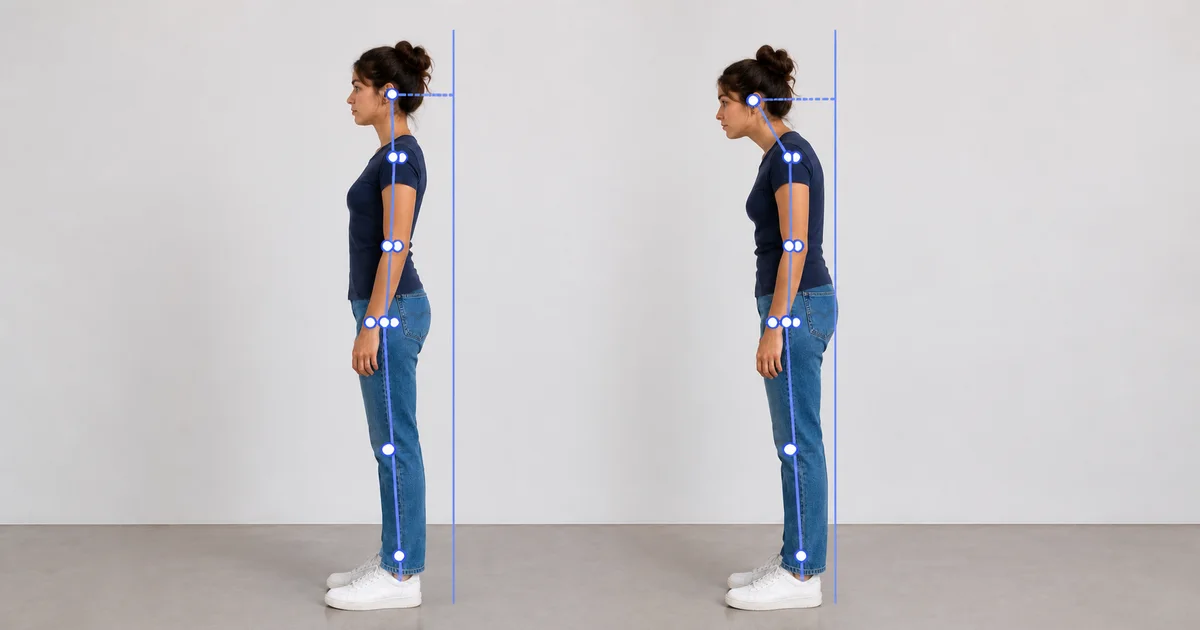
Forward head posture means the head sits in front of the shoulders instead of over them. From the side, the ear is ahead of the shoulder, the chin pokes forward and the upper back often looks rounded. Clinicians measure it with the craniovertebral angle (CVA), and studies put the forward-head cut-off anywhere from 44° to 54°. It is a postural pattern, not a diagnosis: a side photo shows the pattern, but it can’t tell you whether it is causing any symptoms.
What forward head posture is
Forward head posture describes a head carried in front of the line of the shoulders rather than balanced over them. Searches for “forward head tilt posture” usually mean the same head-forward position. Viewed from the side, the outer ear sits ahead of the point of the shoulder, the chin juts forward (sometimes called “chin poke”), and the upper back often shows more rounding (thoracic kyphosis).
The clinical measure is the craniovertebral angle: the angle between a horizontal line through the C7 vertebra, the bony bump at the base of the neck, and a line from C7 to the tragus, the small flap in front of the ear canal. The further forward the head, the smaller the angle. No single cut-off is agreed. Reviewing the literature, Titcomb and colleagues (2024) found forward head posture defined anywhere from a CVA of 44° or less to 54° or less.
Forward head posture is a description of position, and a forward head is not automatically a medical problem. In a 2018 study of 44 adults with forward head posture, all with a CVA below 52°, the 22 with neck pain averaged a CVA of 44.4° and the 22 without pain averaged 48.6° (Kim et al.). That is a one-time comparison between two small groups: it shows that people with and without pain overlap on this measure, and it does not show that a smaller angle causes pain.
Who has it
Forward head posture is often linked with long hours at computers and phones; the screen-related version has its own popular name, tech neck. In a 2023 study of 73 young IT professionals assessed sitting at work, the average CVA was 32°, which the authors classed as light forward head posture, and a smaller angle went with older age and longer work experience (Stincel et al.). Published figures vary widely with the group studied and the way the angle is measured, so a number from one study can’t be read as a norm for everyone.
For reading a photo, this means that an ear sitting slightly ahead of the shoulder does not, on its own, mean anything is wrong. A person with a visible forward head and no pain, headaches or limits on movement is closer to the norm than to an outlier. The photo matters more when the forward position is marked and comes with persistent neck or upper-back pain, recurring headaches or arm symptoms; the section on when to see a clinician below lists those signs.
What forward head posture looks like in a side photo
The clearest view is a side photo taken with the camera at hip height and level, with you standing far enough back that your body fills about two-thirds of the frame height (roughly 2 m on the 1× lens or 3 m on 2×, our estimate). From that angle, a few signs tend to appear together.
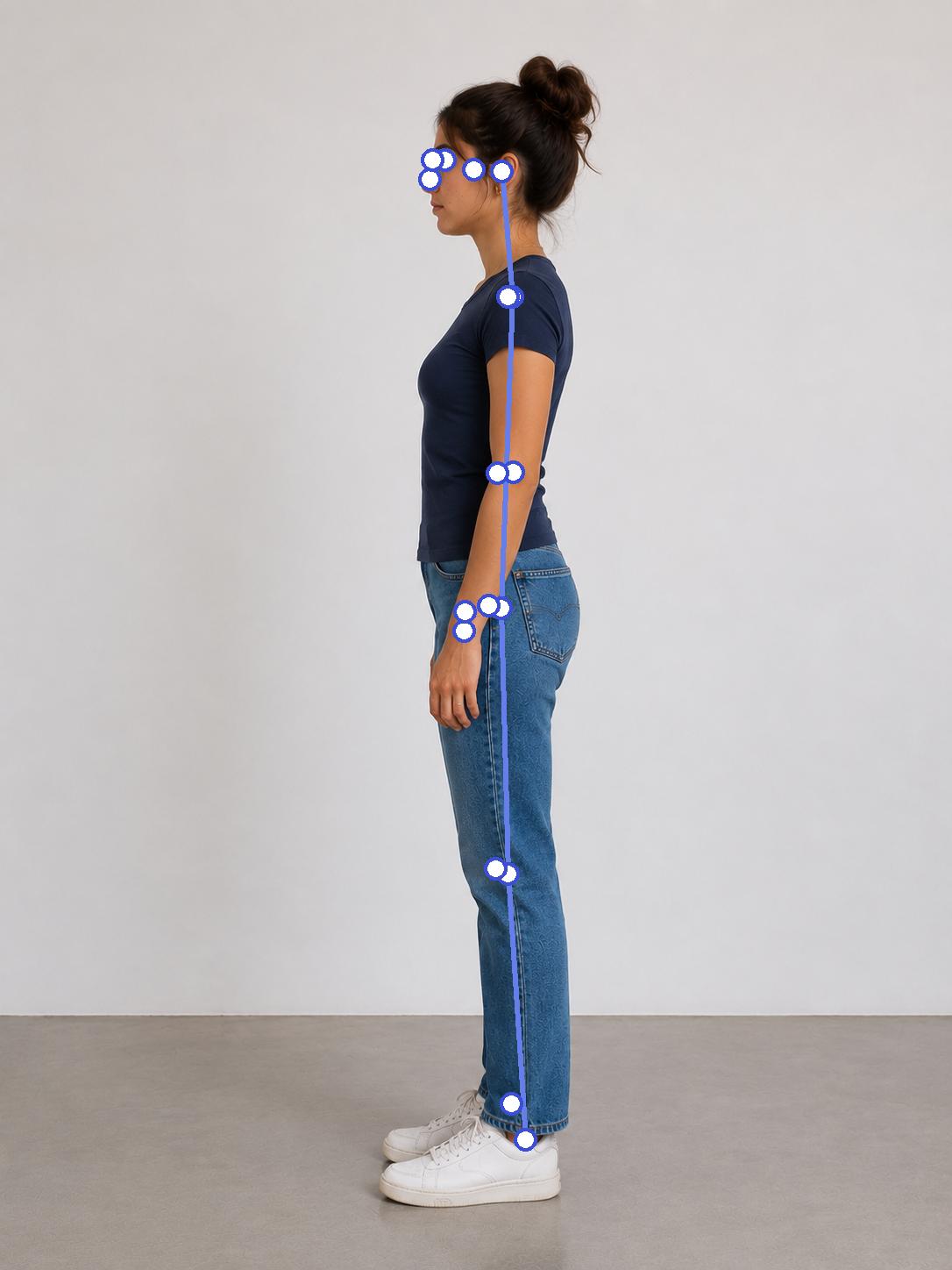
The first and most reliable is the ear-to-shoulder relationship. In a neutral side view, a vertical line dropped from the ear passes close to the middle of the shoulder; that line is the top of the reference used in plumb line posture, which runs on through the hip, knee and ankle. With forward head posture, the ear sits clearly in front of the line. The second sign is the chin, which tends to poke forward and slightly up. The third is the upper back, which often looks more rounded, and the fourth is a slight shortening at the back of the neck as the upper neck tips back to keep the eyes level. A related but different pattern is a flattened or reversed neck curve, sometimes called military neck: it can come with a forward head, but it describes the curve of the neck bones on an X-ray rather than the head’s position.
| NeutralHead stacked | Forward head postureHead in front | |
|---|---|---|
| Ear vs shoulder (side view) | Ear over the shoulder | Ear ahead of the shoulder |
| Craniovertebral angle | Larger (more open) | Smaller (more acute) |
| Chin | Level or slightly tucked | Pokes forward |
| Upper back | Neutral curve | Often more rounded |
| Typical context | — | Long screen / desk time |
Common photo conditions distort these signs. A camera well above or below hip height, or tilted, changes the apparent ear-shoulder relationship; a three-quarter angle instead of a true side view makes the comparison unreliable; and long hair or a high collar can hide the ear and the base of the neck.
These signs are surface features that suggest where the head sits. They are not the craniovertebral angle measured on marked photos or X-rays, and they are most useful for comparing the same person over time under the same setup.
How to take a side photo to see it
Most distortion comes from the camera, not the body, so the full setup is in how to take posture photos, and the at-home posture check explains how to read the result. For a forward-head check, the points that matter most:
- Background. Stand side-on to a plain wall.
- Body position. Stand naturally, weight even, arms relaxed, looking straight ahead, not up or down. Don’t straighten up for the photo.
- Camera height and level. Lens at about hip height, with the phone level; use its level indicator, because a tilted camera skews every angle in the photo.
- Distance. Stand back until your body fills about two-thirds of the frame height: roughly 2 m on the 1× lens or 3 m on 2× (our estimate). Avoid the 0.5× lens.
- Framing. Keep your whole body in frame, head to feet.
- Hair and clothing. Tie back long hair and avoid high collars so the ear and the base of the neck show.
A repeat photo taken the same way a few weeks later tells you more than a single shot. The sample report, made for a fictional client, shows what the readings look like, and the methodology page documents how each metric is computed from the photo’s keypoints.
How PosturaScreen estimates forward head from a photo
PosturaScreen, the product behind this article, reports forward head posture from one side photo as two metrics. Forward Head is the angle of the line from the shoulder keypoint to the ear keypoint, measured from vertical; its report range is under 12°. Ear-Shoulder is the horizontal distance between the same two points in centimetres; its range is under 2.5 cm. For both, a larger number means the ear sits further from directly above the shoulder.
Forward Head carries the approx tag (saved reports label it “Estimated”). The calculation captures the surface relationship between the ear and the shoulder in the photo. It does not reproduce the clinical craniovertebral angle, because the pose model has no C7 or tragus point, and the two angles use different reference lines: Forward Head grows as the head moves forward, while the CVA shrinks. The craniovertebral angle guide explains why one can’t be converted into the other.
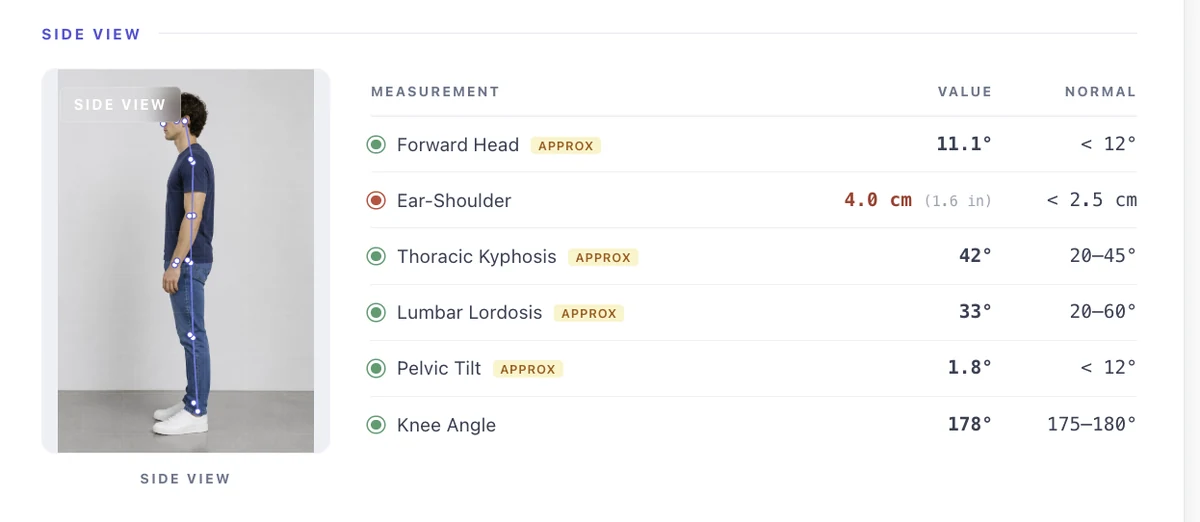
The two numbers can disagree, as the sample report shows, because the angle also depends on how far the ear sits above the shoulder point. Either reading is most useful next to the same person’s earlier readings, taken with the same setup. No minimum change has been published for PosturaScreen’s Forward Head, so a difference between two photos doesn’t by itself show that head position has changed. Forward head is one of the 17 posture metrics; for the pelvis pattern that is often discussed alongside it, see anterior pelvic tilt.
If forward head appears in your report, what to do next after posture screening lays out a conservative track-and-recheck approach before the symptom guidance below.
When to see a clinician about forward head posture
A visible forward head in a side photo does not need a clinical visit on its own. It is worth a licensed physiotherapist’s, physician’s or chiropractor’s attention when it comes with one or more of these:
- Persistent neck, shoulder or upper-back pain that does not settle with rest or keeps coming back with activity.
- Recurring headaches, particularly ones that start at the base of the skull.
- Numbness, tingling or weakness in the arms or hands. These need evaluation whatever your posture looks like.
- A recent change, such as a forward head that wasn’t there before, especially after an injury.
A clinician can combine the photo with a history and physical examination and decide whether anything needs treatment, monitoring or nothing at all; many clinics use posture screening software for clinics to record and track that signal between visits. A photo can’t do that part: it does not measure pain, strength or tissue health.
How this article was made: the study figures come from the papers linked in the text, opened in October 2026. The camera distances are our own estimate, explained in the photo guide. The description of PosturaScreen’s metrics comes from its analysis code and the published methodology; the sample report is fictional. It is for posture education, is not medical advice and is not a substitute for a clinical evaluation. PosturaScreen is a screening and tracking tool, not a diagnostic device. See our editorial standards for how articles are written.
Free posture screening, in seconds.
Start with one photo. Add the second for all 17 metrics. No account or app required.
Start a free posture screen