Winged Scapula: What a Protruding Shoulder Blade Looks Like
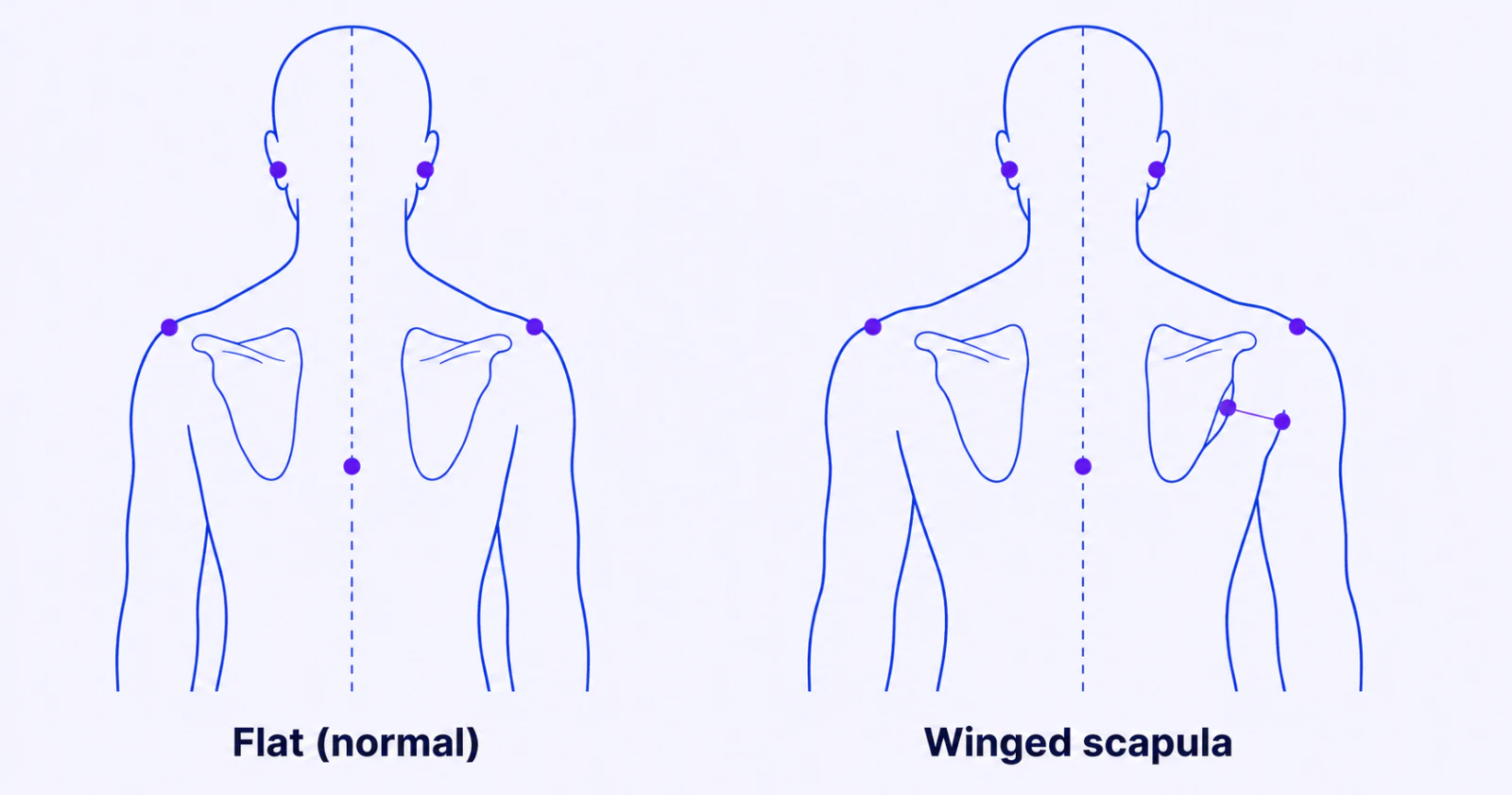
A winged scapula — also called a flying scapula — is a shoulder blade whose inner edge lifts away from the ribcage instead of lying flat against it, so the bone visibly protrudes under the skin of the upper back. It is a back-view finding — most obvious from behind, and often more pronounced during movement than at rest. Unlike the posture patterns this site usually covers, a winged scapula is more frequently associated with an underlying muscle or nerve cause, so a noticeable one is worth a clinical look rather than self-assessment. This guide explains what a winged scapula looks like, how it is usually spotted, how it differs from rounded shoulders, and — honestly — why a two-photo posture screen cannot detect it.
- A winged scapula = the inner edge of the shoulder blade lifts off the ribcage and sticks out on the upper back.
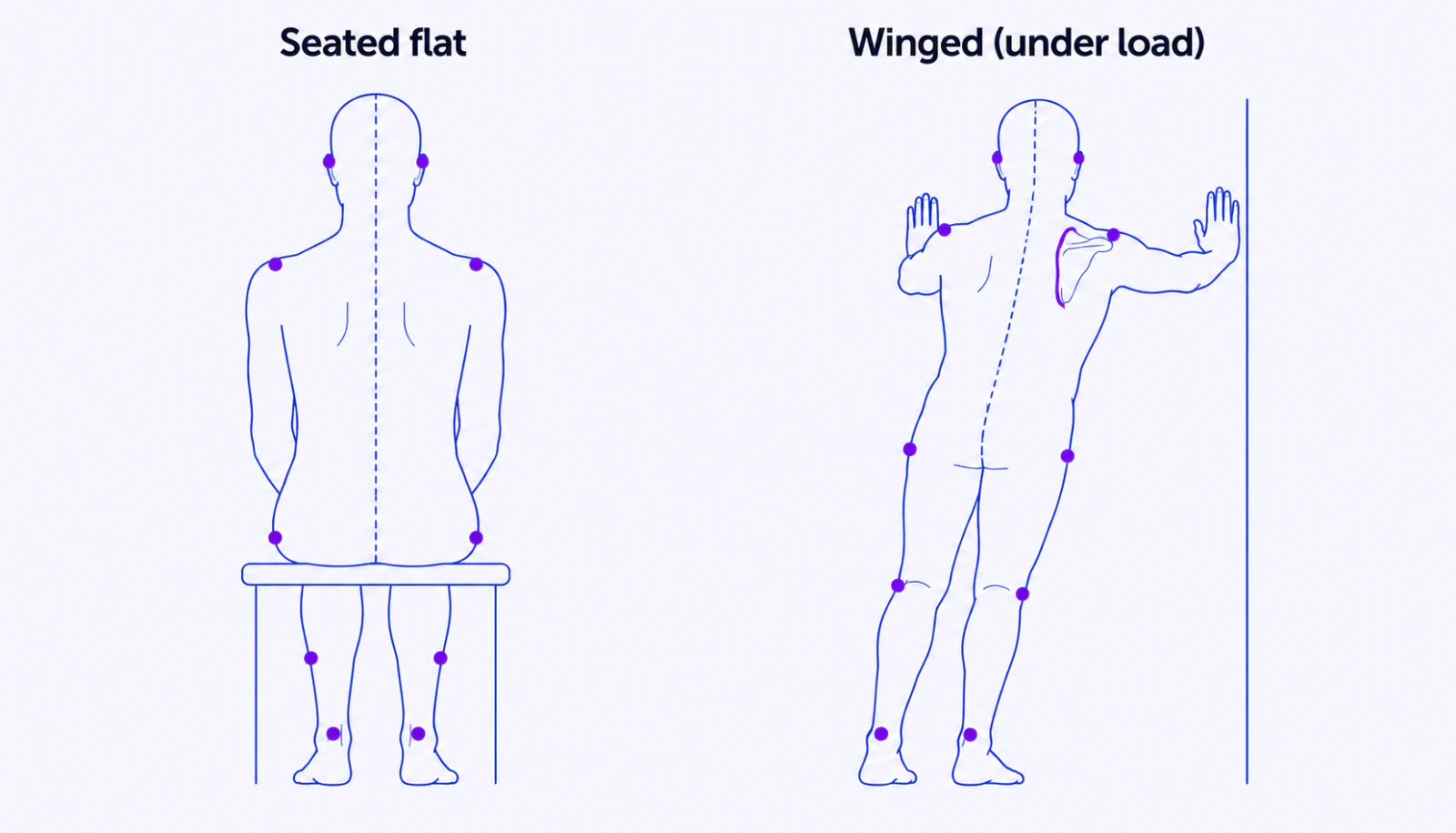
- It is a back-view, movement-dependent finding — best seen from behind, often during a wall push-up. It is usually invisible from the front.
- It is not the same as rounded shoulders, which is a side-view forward shoulder position.
- Because causes range from muscle activation to nerve involvement, a noticeable winged scapula is worth a clinical evaluation — more so than a simple postural variant.
- A two-photo posture screen cannot detect scapular winging. Front-and-side screening (including PosturaScreen) can flag shoulder-height asymmetry and rounded-shoulder posture, but not the winging itself.
What a winged scapula is
The scapula — the shoulder blade — is a flat, triangular bone that normally glides smoothly across the back of the ribcage, held close to it by the muscles that surround it. A winged scapula — also called scapular winging, a winged shoulder blade, or a flying scapula — is the condition where the inner border of that bone lifts away from the ribcage and protrudes backward, so it stands out under the skin instead of lying flat. The “flying scapula” name is just a more vivid label for the same appearance: the blade looks as though it is trying to lift off the back like a wing.
The muscle most often discussed in connection with scapular winging is the serratus anterior, which wraps around the ribcage and holds the inner border of the scapula flat against it. When that muscle does not stabilize the blade effectively — for a range of possible reasons — the inner border can lift, producing the winged appearance. Other muscles, including the trapezius and rhomboids, contribute to keeping the scapula seated, and different patterns of winging are associated with different muscles.
This is where a winged scapula differs from most of the posture patterns covered on this site. An anterior pelvic tilt or a deep lumbar lordosis is usually a postural variation that sits within a normal range. Scapular winging is more often a sign — something that points to how the muscles and nerves controlling the shoulder blade are working. Some causes are minor and posture-related; others, such as involvement of the long thoracic nerve, are medical and need evaluation. That difference is the reason this article leans harder on “see a clinician” than the others.
Throughout this guide, the focus stays on what a winged scapula looks like and how it is observed — not on causes, treatment, or exercises, which are clinical questions for a qualified professional.
How a winged scapula is usually spotted
A winged scapula is not read from a casual standing photo the way a pelvic tilt or a lower-back curve is. It is a back-view finding, and it frequently depends on movement, so the way it is spotted is different.
The clearest view is from directly behind, with the upper back exposed or in close-fitting clothing. At rest, a pronounced winging may already be visible as one or both shoulder blades standing proud of the back. But many cases are subtle at rest and only become obvious under load — which is why the wall push-up test is the common way to bring it out. The person places both hands flat on a wall at about shoulder height and gently pushes, as if doing a standing push-up. If a scapula wings, its inner border pops out away from the ribcage during the push. Raising the arm overhead and lowering it slowly can reveal the same thing.
This movement dependence is important. A winged scapula is fundamentally about how the shoulder blade is controlled during activity, not just where it sits in a still frame. A static photo — even a back-view one — can miss winging that only appears when the muscle is challenged. Clinicians account for this by watching the blade move, not just by looking at a snapshot.
It also explains why front-and-side posture photography, the standard for most posture screening, is the wrong tool for this particular finding. The protrusion is on the back; a front photo cannot see it, and a side photo shows it only obliquely and only if it is severe. The honest section below covers what front-and-side screening can contribute.
What a winged scapula looks like
When a winged scapula is visible, several features tend to appear together on a back view.
The most direct sign is a shoulder blade standing out from the back. Instead of a smooth upper-back contour, the inner edge of the blade lifts, creating a raised, wing-like ridge under the skin — the appearance that gives the condition its name. In lean people this can be quite dramatic; in others it is a subtler bump that becomes obvious only on movement.
A second feature is asymmetry between the two sides. Winging is often more pronounced on one side than the other, so a back view may show one blade sitting flat and the other protruding. This side-to-side difference is part of why it draws attention — the two sides of the upper back no longer match.
A third feature is the change under load. As described above, the protrusion frequently increases during a wall push-up or when the arm is raised and lowered. A blade that looks nearly flat at rest can wing clearly under that small challenge.
The terms medial and lateral winging describe which way the blade rotates as it lifts, and they are associated with different muscles — but distinguishing them is a clinical judgment made during a physical examination, not something to determine from a photograph.
Winged scapula vs rounded shoulders
The two findings are easy to confuse because both involve the shoulder region and the upper back, but they are different things seen from different angles. Rounded shoulders is one of the most common posture patterns; scapular winging is a more specific finding. The table below contrasts them.
| Winged scapulaBack-view finding | Rounded shouldersSide-view posture | |
|---|---|---|
| What it is | Inner edge of the shoulder blade lifts off the ribcage | Whole shoulder sits forward and rolled inward |
| Best view to see it | From behind | From the side |
| Depends on movement | Often — clearer during a wall push-up | No — visible in a still side photo |
| Typical association | Muscle or nerve control of the scapula | Posture habits, upper-back rounding |
| Front/side photo screen detects it? | No | Yes — as forward-shoulder posture |
For the rounded-shoulder pattern — which a posture screen can see — the related reading is the guide on forward head posture, since the two often travel together as part of an upper-body forward posture.
What PosturaScreen can and cannot see
This is the honest part. PosturaScreen is a two-photo posture screen: it analyzes a front-view and a side-view photo to produce 17 posture metrics (you can see them in a sample report). That design is well-suited to a range of posture metrics — and poorly suited to scapular winging. It is worth being precise about both.
What the screen can contribute around the shoulder region:
- Shoulder-height asymmetry — from the front view, the vertical offset between the left and right shoulder keypoints (reported as shoulder level and clavicle angle). If winging is part of a broader one-sided shoulder pattern, this asymmetry may show up — but it is a different measurement, not winging.
- Rounded-shoulder / forward-shoulder posture — from the side view, via the thoracic-kyphosis and head-position estimates. This captures the forward upper-body posture that sometimes accompanies shoulder problems.

What the screen cannot do is detect scapular winging itself. The reasons are concrete:
- Wrong view. Winging shows on the back. The screen uses front and side photos.
- No landmark for it. The body keypoints the model detects mark the shoulder joints, not the inner border of the shoulder blade, so there is no landmark that would register the protrusion.
- Movement dependence. Much winging only appears under load, during a wall push-up — a still photo cannot reproduce that.
Stating this plainly matters more than capturing a search term. PosturaScreen is a screening and tracking tool for the posture metrics it actually measures; scapular winging is not one of them. Anyone who suspects a winged scapula is better served by a clinician than by a posture photo — and the next section explains why that is the right call.
What winged scapula looks like in a photo
People often try to confirm a winged scapula from a photograph — a phone picture taken from behind, or a side-view shot. A photo can show the appearance, and it helps to know what to look for and which view actually shows it. The honest caveat first: a 2D photo captures how the shoulder blade looks in a single frame, not why it looks that way. It cannot tell whether the cause is muscular, postural, or neurological. That remains a clinical judgment.
From the back view — the angle where winging reads most clearly — the inner edge of the shoulder blade lifts off the smooth contour of the upper back and casts a wing-like ridge or shadow under the skin. On a still back-view photo, a pronounced case shows as one or both blades standing proud; a subtler case may barely register, because the protrusion often only appears under load during a wall push-up, which a single frame does not reproduce. Asymmetry is a common tell: in a back-view photo one blade may sit flat while the other stands out, so the two sides of the upper back no longer mirror each other.
From the side view — the “winged scapula side view” people often search for — the picture is much less reliable. A side photo shows the shoulder blade only obliquely, so unless the winging is fairly severe it tends to blend into the upper-back outline rather than reading as a distinct protrusion. What a side view shows more clearly is rounded-shoulder posture — the shoulders sitting forward of the ears — which can travel alongside shoulder-blade problems but is a separate finding from winging itself.
This is also where PosturaScreen fits in honestly. The screen works from a front and a side photo, so it can flag shoulder-blade-adjacent signals — shoulder-height asymmetry from the front, and rounded-shoulder posture from the side — and surface them as measured metrics you can track over time. What it does not do is detect shoulder-blade prominence as winging: there is no keypoint on the inner border of the scapula, the protrusion lives on the back rather than the front or side, and much winging is movement-dependent. So a photo — whether a casual one or a PosturaScreen capture — can hint at the surrounding posture, but reading a true winged scapula from an image is exactly the appearance-versus-cause gap that a clinician closes in person.
What causes scapular winging
This section stays descriptive: it explains, at a general anatomical level, why a shoulder blade wings — not how to treat it, which is a clinical question. The short version is that the scapula stays flat against the ribcage only as long as the muscles anchoring it do their job, and winging appears when that anchoring is disrupted.
The muscle most associated with winging is the serratus anterior, which wraps around the side of the ribcage and holds the inner border of the scapula down against it. The serratus anterior is supplied by the long thoracic nerve. When that nerve or muscle is not working effectively, the inner border can lift — the classic medial winging pattern. Other muscles contribute too: the trapezius (supplied by the spinal accessory nerve) and the rhomboids also help seat the blade, and disruption to them is associated with other winging patterns.
The reasons that anchoring breaks down range widely. Some are postural or related to how the surrounding muscles are activating; others are neurological — involving the nerves that drive these muscles — and some follow an injury, an illness, or a period of unusual load on the shoulder. Because a still photograph and even a posture screen cannot distinguish a benign muscular pattern from nerve involvement, and because the underlying cause genuinely changes what the finding means, scapular winging is one of the clearer cases where an in-person clinician evaluation matters rather than self-assessment from an image.
When to see a clinician about a winged scapula
For most posture patterns covered on this site, the guidance is that a visible sign alone rarely needs a clinical visit. A winged scapula is different. Because it can reflect how the nerves and muscles controlling the shoulder blade are functioning, a noticeable or persistent winged scapula is worth having evaluated — even without pain.
It is especially worth a prompt clinical visit when winging appears alongside any of the following:
- Weakness in the arm or shoulder, difficulty lifting the arm overhead, or fatigue with overhead activity.
- Pain around the shoulder blade, shoulder, or neck that persists or recurs.
- A recent onset — winging that appeared after an injury, an illness, surgery, or carrying a heavy load — particularly if it came on relatively suddenly.
- Numbness, tingling, or a sensory change in the arm. Any neurological symptom warrants evaluation independent of the winging itself.
The professionals positioned to assess a winged scapula include physiotherapists, sports-medicine physicians, orthopedic specialists, and neurologists. They can examine the shoulder blade in motion, test the relevant muscles and nerves, and determine whether the winging reflects something that needs treatment. The Cleveland Clinic overview of winged scapula explains the nerve and muscle causes and when shoulder symptoms are worth a visit to a healthcare provider.
Practitioners who already see these clients can run the same front-and-side posture screening in their own clinic as a repeatable baseline alongside their hands-on examination — the basis of posture screening software for practitioners — while the winging itself stays a matter for in-person assessment, including the back-view step of a static postural assessment.
PosturaScreen is built as a screening and tracking tool for the posture metrics it measures. It does not detect scapular winging, it is not a diagnostic device, and it does not provide medical advice. The information in this article is educational. For a suspected winged scapula, the right next step is a conversation with a qualified healthcare professional.
Frequently asked questions
What is a flying scapula?
A flying scapula is another name for a winged scapula — the same condition described in more vivid terms. It refers to a shoulder blade whose inner edge lifts away from the ribcage so the bone stands out under the skin of the upper back, as though the blade were trying to lift off like a wing. Whether it is called a winged scapula, a flying scapula, scapular winging, or a winged shoulder blade, the finding is the same and the appropriate next step for a noticeable one is a clinical evaluation rather than self-assessment.
What does a winged scapula look like?
A winged scapula is a shoulder blade whose inner edge lifts away from the ribcage instead of lying flat against it, so the bone sticks out under the skin of the upper back. It is most visible from behind, and it often becomes more obvious when the person pushes against a wall or raises the arm, because the blade pops out further under load. From the front it is usually not visible at all.
What does winged scapula look like in a photo?
In a back-view photo, a winged scapula appears as the inner edge of the shoulder blade lifting off the smooth contour of the upper back, casting a wing-like ridge or shadow under the skin — often more on one side than the other. A side-view photo is much less reliable, because the blade shows only obliquely and tends to blend into the upper-back outline unless the winging is severe; what a side view shows more clearly is rounded-shoulder posture, which is a separate finding. A photo can show the appearance but not the cause, so a noticeable winged scapula still warrants an in-person clinician assessment.
How is a winged scapula different from rounded shoulders?
Rounded shoulders is a forward-and-inward position of the whole shoulder, visible from the side as shoulders that sit ahead of the ears. A winged scapula is a shoulder blade lifting off the ribcage at the back, visible from behind as a protruding bone. They can occur together, but they are different things seen from different angles — rounded shoulders is a side-view posture, winging is a back-view finding.
Can a posture app or 2D photo detect a winged scapula?
Generally no. Scapular winging is a back-view, often movement-dependent finding — clinicians check it from behind, frequently during a wall push-up. A two-photo screen using front and side images, like PosturaScreen, can flag shoulder-height asymmetry and rounded-shoulder posture, but it does not capture scapular winging itself, because the protrusion is on the back and the standard keypoints do not include the inner border of the shoulder blade.
Is a winged scapula serious?
It depends on the cause. Some winging is related to muscle activation or posture and is mild; some is related to nerve involvement (for example the long thoracic nerve and the serratus anterior muscle) and warrants medical attention. Because the causes range from minor to ones that need evaluation, a noticeable or persistent winged scapula is worth a clinical look — more so than a simple postural variant. A photograph cannot tell the difference; a clinician can.
How do clinicians check for a winged scapula?
A clinician typically observes the upper back from behind, both at rest and during movement, and often uses a wall push-up: the person presses their hands against a wall and the examiner watches whether a shoulder blade pops out. They combine this with a physical examination, a history, and sometimes nerve or muscle testing. This is the kind of assessment a 2D photo cannot replace.
What’s the difference between medial and lateral scapular winging?
The terms describe which way the shoulder blade rotates as it lifts off the ribcage. In medial winging, the inner border moves toward the spine and backward — most often associated with serratus anterior involvement. In lateral winging, the inner border rotates the other way — often associated with trapezius involvement. Distinguishing them is a clinical assessment, not something a photograph determines.
This article was prepared by the PosturaScreen editorial team for posture education. It is not medical advice and is not a substitute for a clinical evaluation. PosturaScreen is a screening and tracking tool, not a diagnostic device, and it does not detect scapular winging. If you have concerns about your shoulder or musculoskeletal health, consult a licensed healthcare professional. See our editorial standards for how this article was written and reviewed.
Free posture screening, in seconds.
Start with one photo. Add the second for all 17 metrics. No account or app required.
Start a free posture screen