Tech Neck Pictures: 4 Signs in a Side-View Photo
Tech neck is an informal name for a head-forward posture often discussed in relation to screen use. A side photo can show the position of your head and shoulders, but it cannot establish a diagnosis or measure the underlying spinal curve. Start with the visual comparison below.
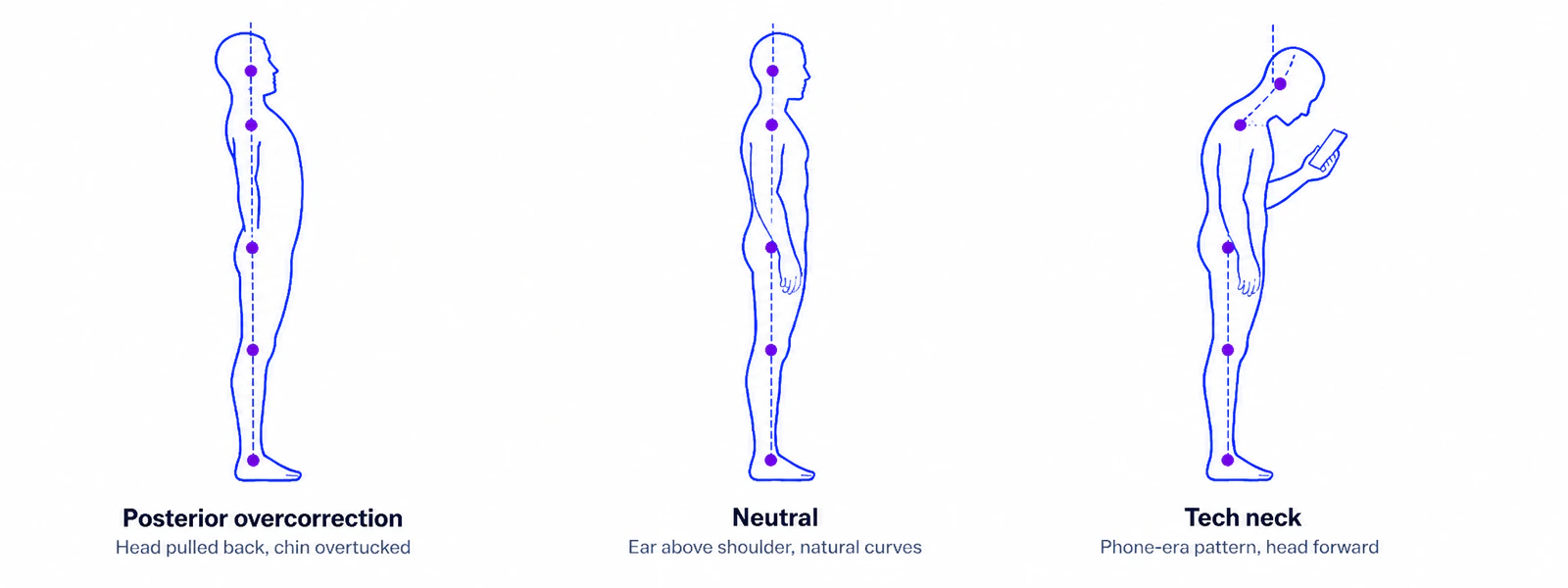
- Tech neck is a postural pattern from sustained downward gaze at screens; in a side photo it shows up as forward head + straighter-looking neck outline + rounded upper back + elevated, forward shoulders.
- The most reliable check is a side-view full-body photo with the camera level at hip height and the body filling about two-thirds of the frame height, in everyday clothing.
- A 2D photo lets a person track changes in head and neck position over weeks of changing screen habits — that is the strongest use case, not a one-time grade.
- When visible tech neck signs occur alongside persistent pain, stiffness, headaches, or numbness, it is worth discussing with a licensed physiotherapist, physician, or chiropractor.
The four visible signs of tech neck in a side photo
The teaching point of a side photo is that tech neck is not one thing — it is a coordinated pattern of four visible signs that tend to appear together. Recognizing all four makes the pattern much easier to identify than scanning for any single sign in isolation.
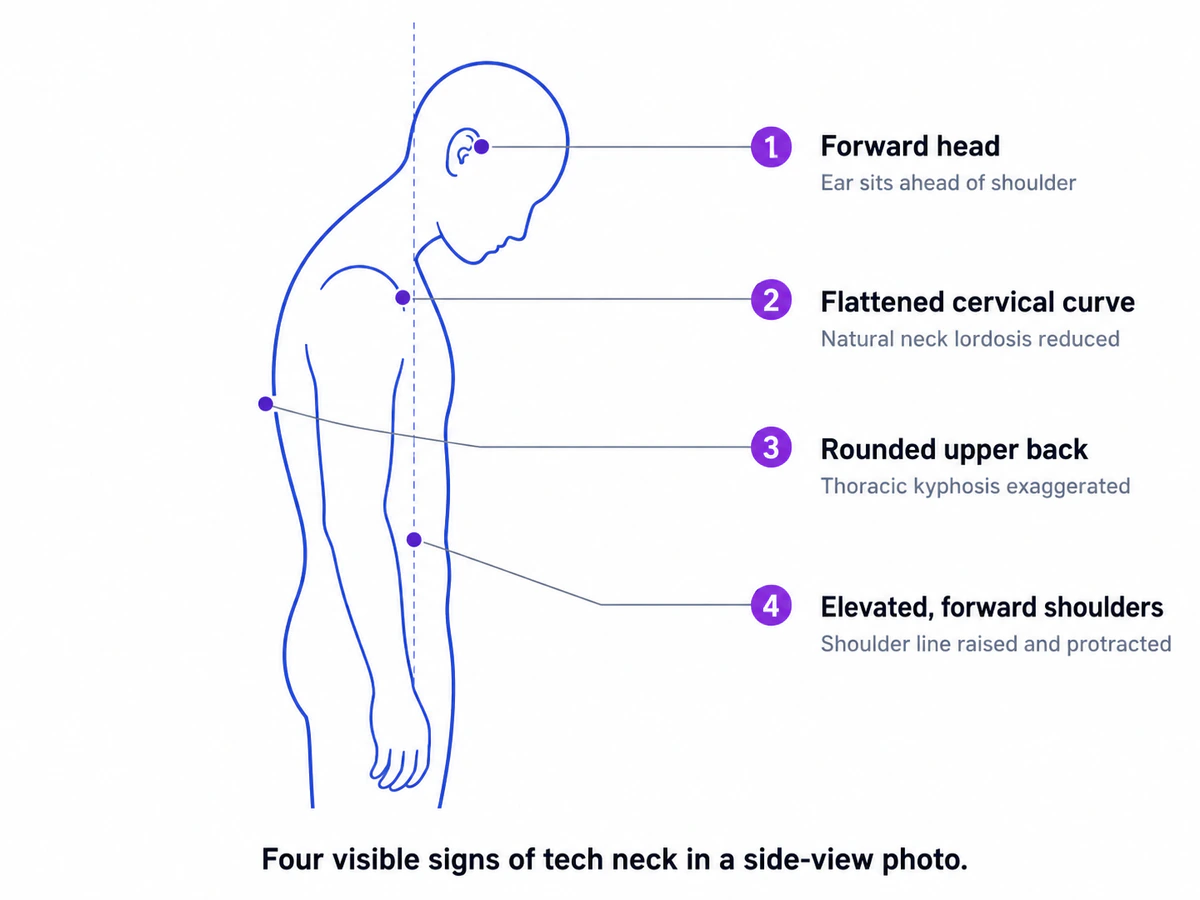
1. Forward head. The defining sign. In a neutral standing photo, the ear sits directly above the shoulder, close to the plumb line used to judge side-view alignment. In tech neck, the ear sits visibly ahead of the shoulder — sometimes by a few centimeters, sometimes by more. The head appears to lead the body. This offset can be quantified as a Forward Head angle from photo landmarks; the 17 measurable posture metrics PosturaScreen reports include exactly this measurement.
2. Straighter-looking neck outline (surface only). The back of the neck can look straighter than its usual gentle curve. This is a surface observation. It does not establish whether the underlying cervical spine has lost its natural curve — that is military neck, a finding measured on a side-view neck X-ray, and it cannot be determined from a photograph.
3. Rounded upper back. As the head moves forward, the upper back tends to round more than usual to support the new center of mass. The visible signal is an exaggerated curvature in the thoracic spine — what clinicians call thoracic kyphosis. A small amount of thoracic kyphosis is normal and healthy; the tech neck pattern shows visibly more than that baseline.
4. Elevated and forward-rolled shoulders. The shoulders compensate for the forward head by riding higher and tilting forward. In a side photo, the line from the base of the neck to the shoulder appears raised, and the shoulders themselves look protracted rather than relaxed.
It is worth emphasizing what these visual signs are not. They are not measurements of any underlying skeletal angle the way a radiograph would measure them. They are surface-contour patterns that suggest the underlying cervical and thoracic geometry. Clothing fit, body composition, breathing phase, and the exact moment the photo is taken all influence what shows up. The visual signal is genuinely useful, especially for trending over time in the same person under the same conditions — but it is a screening signal, not a diagnostic measurement.
Tech neck vs normal neck posture in a side view
Cervical posture is not a binary of good and bad. It sits on a spectrum, with neutral in the middle and two distinct off-neutral patterns at either end.
On one end of the spectrum is tech neck — the head-forward, upper-back-rounded pattern just described. On the opposite end is what physiotherapists sometimes call posterior overcorrection: a posture where the head is pulled back behind the shoulders, the chin is tucked deeply, and the shoulders are pulled back and squared. This pattern is most common in people who are deliberately trying to “fix” their posture and overshoot.
Neither extreme is the goal. Neutral cervical posture means the ear sits above the shoulder without effort, the natural forward curve of the neck is preserved, the upper back has a gentle and relaxed roundedness, and the shoulders are level. It feels easy rather than effortful.
| Posterior overcorrectionHead pulled back | NeutralReference position | Tech neckPhone-era pattern | |
|---|---|---|---|
| Head position | Pulled back behind shoulders | Ear above shoulder | Forward, ahead of shoulders |
| Upper back | Forced flat, anti-kyphotic | Gently rounded (healthy) | Moderately rounded, kyphosis exaggerated |
| Shoulder line | Pulled back and squared | Relaxed and level | Elevated and rolled forward |
| Photo signature | Ear behind plumb line | Ear on plumb line | Ear ahead of plumb line |
| Typical trigger | Effortful "standing tall" attempts | Relaxed everyday stance | Sustained downward gaze at screens |
Clinicians use forward head posture (FHP) to describe the same head-forward geometry without tying it to phone-era triggers. FHP and tech neck describe the same body position; the difference is in the language and the implied cause. Tech neck highlights the trigger (screens and devices). Forward head posture describes the geometry on its own.
How to take a usable side photo to check for tech neck
The side-view workflow mirrors the broader at-home posture photo guide. The setup matters more than the equipment; for camera height, distance and framing in more detail, see how to take posture photos.
Set the phone or camera at hip height and keep it level. Stand sideways to it, far enough back that your body fills about two-thirds of the frame height: roughly 2 m on the 1× lens or 3 m on 2×, our estimate. Use a clean plain wall behind you, with no clutter or competing vertical lines. Wear fitted clothing — a t-shirt and pants are ideal. Baggy hoodies and oversized sweaters hide the shoulder, neck, and upper-back contours that the photo is meant to show. Stand with arms relaxed at the sides, eyes looking forward at a fixed point at eye height, and breathe normally. Do not look at the phone or camera in the moment of capture; that defeats the purpose, since looking at a phone biases the head into the very position being measured. Capture the photo, then move on.
The single most common mistake is “fixing” posture before the shutter clicks. The point of the photo is to record what the body does by default — not what it does when concentrating on standing tall. A baseline-then-tracking workflow is far more informative than a single self-graded snapshot. PosturaScreen’s sample report shows what a sample output looks like from this kind of capture, including the relevant cervical metrics.
How PosturaScreen estimates tech neck markers from photos
PosturaScreen, the product behind this article, estimates two cervical metrics directly relevant to tech neck from a single side-view photo: Forward Head (the angle between the head keypoint and the shoulder reference line, in degrees) and Ear-Shoulder (the horizontal offset between the ear and the shoulder keypoint, in centimeters). Both are computed deterministically from photo keypoints. Forward Head carries an approx tag — it estimates an angle from a flat 2D image — while Ear-Shoulder is a direct horizontal offset, reported without the approx flag, though clothing and stance still affect it, so it is best read as a same-person trend.
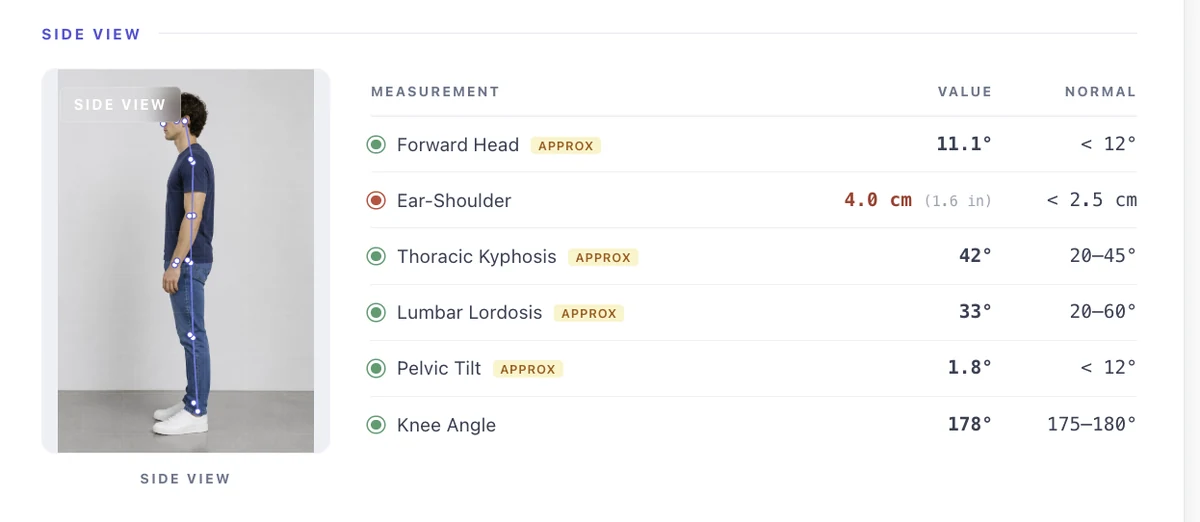
approx as a 2D estimate; Ear-Shoulder is a direct offset. Both differ from radiographic measurement and are best used for same-person tracking.The approx tag is honest about what the numbers represent. They reliably capture the surface relationship between the head, the neck, and the shoulder in the photo. They do not capture the underlying cervical spine angle the way a radiograph would, because surface contour is influenced by clothing, body composition, breathing phase, and small variations in how the subject was standing at the moment of capture. PosturaScreen does not measure cervical spine angle from a radiograph; it estimates visible surface-landmark offsets and is best used to compare the same person over time under similar photo conditions, not to grade absolute clinical severity between individuals. For the clinical craniovertebral angle and how it differs from this photo proxy, see how forward head posture is measured.
The practical value of the numbers is trending. A Forward Head value of 11° today is not directly comparable to someone else’s 11° taken under different conditions, but it is comparable to that same person’s 8° six weeks later, if both photos were taken with the same setup. That is how PosturaScreen tends to be used in practice for tech neck: as a screening signal that initiates a conversation, and as a tracking signal that flags change over time. The full mathematical definition of each metric, including Forward Head and Ear-Shoulder, lives on the PosturaScreen methodology page.
When the photo signs are worth a clinician visit
A side photo showing tech neck signs does not require a clinical visit on its own. As noted earlier, some degree of cervical posture variation is the norm, and a visible tech neck pattern can appear in people with or without symptoms. By itself, the photo finding does not prove the posture is painful, harmful, or clinically significant.
The signal becomes worth a clinician’s attention when it occurs alongside one or more of the following:
- Persistent pain or stiffness in the neck, shoulders, or upper back that does not resolve with normal rest.
- Frequent or severe headaches, especially headaches that begin at the base of the skull or behind the eyes.
- Restricted ability to turn the head, look up, or look behind.
- Any numbness, tingling, or weakness in the arms or hands — these are neurological signals that warrant prompt evaluation regardless of posture.
Several professional groups are positioned to integrate a photo signal with the rest of someone’s clinical picture: licensed physiotherapists, physicians, chiropractors, sports-medicine specialists, and orthopedic clinicians. Many of these practices use posture screening software for practitioners to capture the same side-view signal in the clinic and track it alongside their own examination. They can perform a physical examination, take a history, and decide whether the postural pattern observed in a photograph is worth further investigation, treatment, or simply monitoring over time. OrthoInfo from the American Academy of Orthopaedic Surgeons and the Mayo Clinic neck-pain overview are reasonable starting points for understanding when persistent neck concerns warrant clinical evaluation.
What a photograph cannot do is replace any of that. A photograph is a snapshot of surface contour at a moment in time. It does not measure pain. It does not measure tissue health. It does not capture the dozens of other things a clinician integrates into an assessment. For a related pelvic-posture pattern, the same logic applies — see our visual guide to anterior pelvic tilt for the equivalent framing on the pelvis.
PosturaScreen is built as a screening and tracking tool. It is not a diagnostic device, and it does not provide medical advice. The information in this article is educational. For specific concerns about posture or musculoskeletal health, the right next step is a conversation with a qualified healthcare professional.
Frequently asked questions
What does tech neck look like?
From a side-view photo, tech neck shows up as four visible signs: the head sits forward of the shoulders, the back of the neck looks straighter than its natural gentle curve, the upper back is more rounded, and the shoulders ride higher and are rolled forward. These signs are easiest to spot when the camera is level at hip height, the body fills about two-thirds of the frame height (roughly 2 m away on the 1× lens or 3 m on 2×, our estimate), and the person is standing relaxed with eyes forward — not looking at a phone in the photo itself.
Is tech neck the same as text neck?
Tech neck and text neck are informal terms often used for head-forward posture associated with screen use. Neither term is a diagnosis.
Can tech neck cause headaches?
Some clinical reports describe an association between sustained forward head positioning and certain types of headache, but a side-view photo alone cannot establish whether any individual’s headaches are tech-neck-related. Headaches have many possible drivers, including sleep, hydration, stress, vision, and underlying medical conditions. If headaches are persistent or severe, the right next step is a licensed physiotherapist, physician, or chiropractor — not a self-interpretation of a posture photo.
Can a 2D photo track tech neck changes over time?
Yes — that is the strongest use case for a photo-based check. A side-view photo taken under consistent conditions lets a person see whether the head-forward distance, upper-back rounding, and shoulder elevation are increasing, stable, or decreasing over weeks or months. PosturaScreen reports two relevant metrics: Forward Head (tagged approx, an angle estimated from a 2D photo) and Ear-Shoulder (a direct horizontal offset). Both are best read as a same-person trend over time.
How accurate is a side photo for tech neck?
A side photo reliably shows the appearance of tech neck — the visible offset of the ear from the shoulder, a straighter-looking neck outline, and the rounding of the upper back. It does not measure the underlying cervical spine angle the way a radiograph would. Clothing, body composition, breathing phase, and small movements at the moment of capture all influence the surface signs. Photo-based readings are best used to track change in the same person over time, not to compare absolute numbers between people.
When should someone see a clinician about tech neck?
When visible tech neck signs in side photos occur alongside ongoing pain, stiffness, frequent headaches, or any numbness or tingling in the arms or hands, it is worth consulting a licensed physiotherapist, physician, or chiropractor. They can integrate the photo signal with a physical examination and history to decide if anything needs intervention. PosturaScreen is a screening and tracking tool, not a diagnostic device.
This article was prepared by the PosturaScreen editorial team for posture education. It is not medical advice and is not a substitute for a clinical evaluation. PosturaScreen is a screening and tracking tool, not a diagnostic device. If you have concerns about your posture or musculoskeletal health, consult a licensed healthcare professional. See our editorial standards for how this article was written and reviewed.
Free posture screening, in seconds.
Start with one photo. Add the second for all 17 metrics. No account or app required.
Start a free posture screen