Military Neck: What a Straightened Neck Curve Means
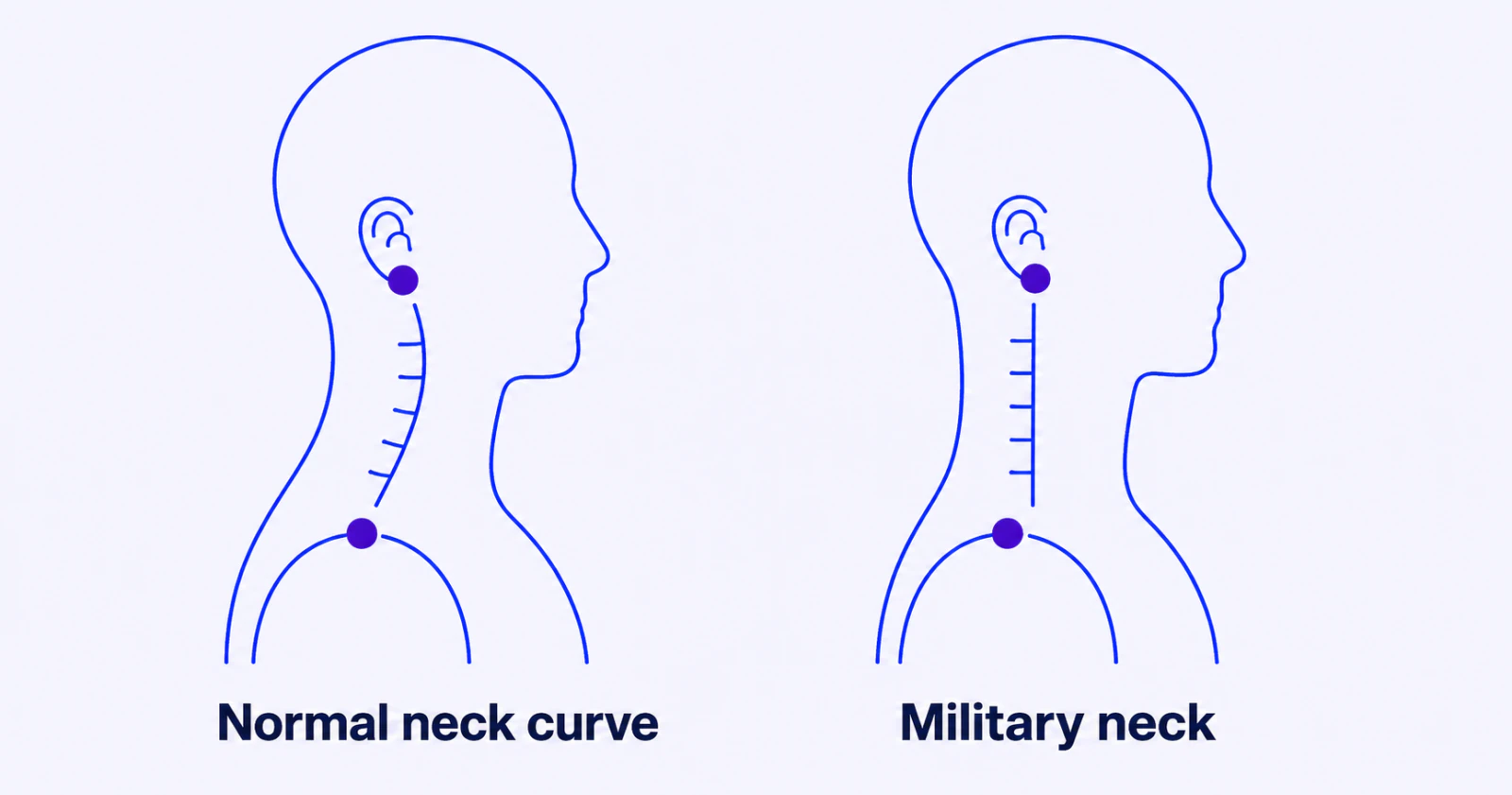
Military neck is the everyday name for a flattened cervical lordosis: on a side-view X-ray of the neck, the normal inward curve is reduced so the neck looks straight, and in some cases the curve is reversed. It is an X-ray finding that a photo can’t measure, and it is common in people without symptoms. In a 2018 meta-analysis, about a third of people with no neck symptoms had no lordotic curve.
What military neck is
The cervical spine, the seven vertebrae of the neck, normally forms a gentle inward curve called the cervical lordosis. Viewed from the side, the middle of the neck curves slightly forward.
Military neck is the common name for a flattening of that curve, so the neck looks straight and upright from the side, as if standing at military attention. X-ray reports describe the same thing in several ways: loss of cervical lordosis, straightening of the cervical lordosis, or hypolordosis. When the curve goes past straight and bends the other way, reports call it a reversal of cervical lordosis or cervical kyphosis.
These terms describe the shape of the neck bones on an image. On their own, they are not a diagnosis and don’t say what, if anything, is causing symptoms. Military neck is about the internal curve of the cervical spine, which is different from how far forward the head sits, an external posture you can see in a photo. The sections below keep those two apart.
How common a straight neck curve is
A straight neck curve is a frequent finding in people who have no neck problems. A 2018 meta-analysis pooled 21 studies of 15,364 people without symptoms, with an average age of 42 (Guo et al.). In the 11 studies of 12,455 people that reported the curve type, about 64% had a lordotic curve, which leaves roughly a third with a straight, reversed or S-shaped one. The average curve also depended on how it was measured: about 13° with the C2–C7 Cobb method and about 19° with the posterior tangent method.
The same analysis found no significant difference in the curve between people with and without symptoms, and no link with age; the curve was larger in men than in women. For someone reading an X-ray report, this means that “straightening of the cervical lordosis” on its own does not explain neck pain. It becomes one piece of evidence that a clinician weighs with your symptoms, your history and an examination.
Whether a flattened curve can change, and whether it needs to, depends on why it is flat in that person, which takes an examination to work out. This guide doesn’t prescribe exercises or a routine. The right approach depends on the cause and on an individual assessment by a licensed physiotherapist or physician.
Military neck vs forward head posture
The two are often confused. They can appear together, and they are not the same thing.
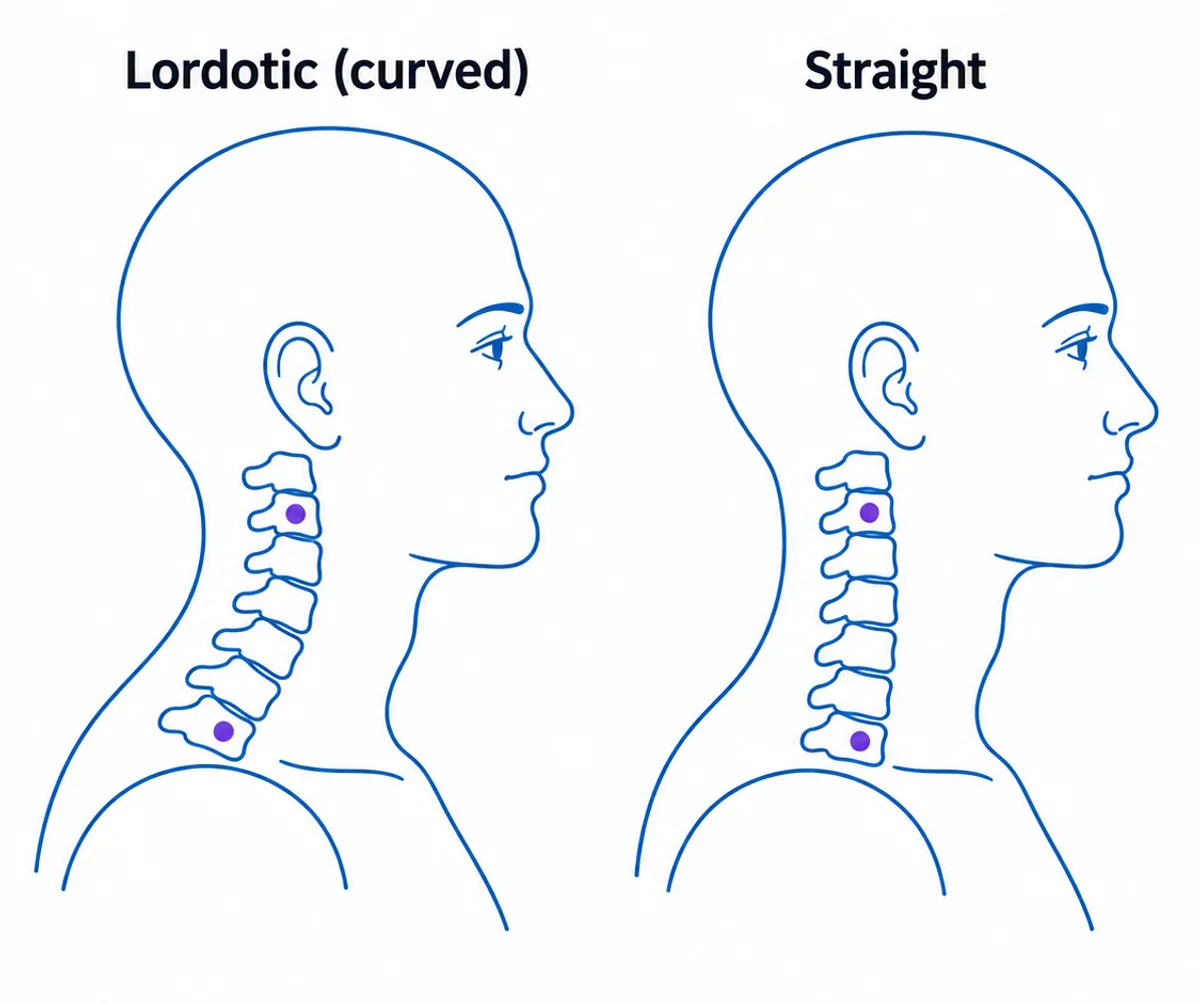
Forward head posture is an external posture: how far the head sits ahead of the shoulders, viewed from the side. In a photo, the ear sits in front of a vertical line through the shoulder, the top of the plumb line reference used to judge side-view alignment. Military neck is an internal curve: the shape of the cervical spine inside the neck, measured on an X-ray. A side photo can show a straighter-looking neck outline, but it can’t show how the vertebrae under the skin are aligned.
Research shows how loosely the two are linked. In a 2024 study of 120 people with chronic muscle pain, each had both a posture photo for the craniovertebral angle, the standard forward-head measure, and a side X-ray of the neck. The angle and the X-ray measure of the neck curve were correlated (Spearman r = 0.52), but the angle accounted for only about 28% of the variation in the curve (R² = 0.28), and the authors concluded that the craniovertebral angle cannot replace an X-ray measure of the cervical lordosis (Oakley et al.). A person can have a forward head with a normal neck curve, or a flattened curve without a marked forward head.
| Military neckInternal curve | Forward head postureExternal posture | |
|---|---|---|
| What it describes | The cervical spine's inward curve | Where the head sits vs the shoulders |
| How it's assessed | Lateral neck X-ray | Side-view photo or observation |
| Visible in a photo? | Only as a straighter-looking outline; the curve itself is inside the neck | Yes: ear ahead of shoulder |
| What it is | A radiographic finding | A posture pattern |
| Measured by a photo posture screen? | No | Yes, as Forward Head and Ear-Shoulder |
The same distinction separates military neck from tech neck, the popular name for a forward head linked with looking down at devices. A tech-neck side photo may show a straighter-looking neck outline, but that surface sign does not confirm a flattened cervical curve.
What PosturaScreen can and cannot see
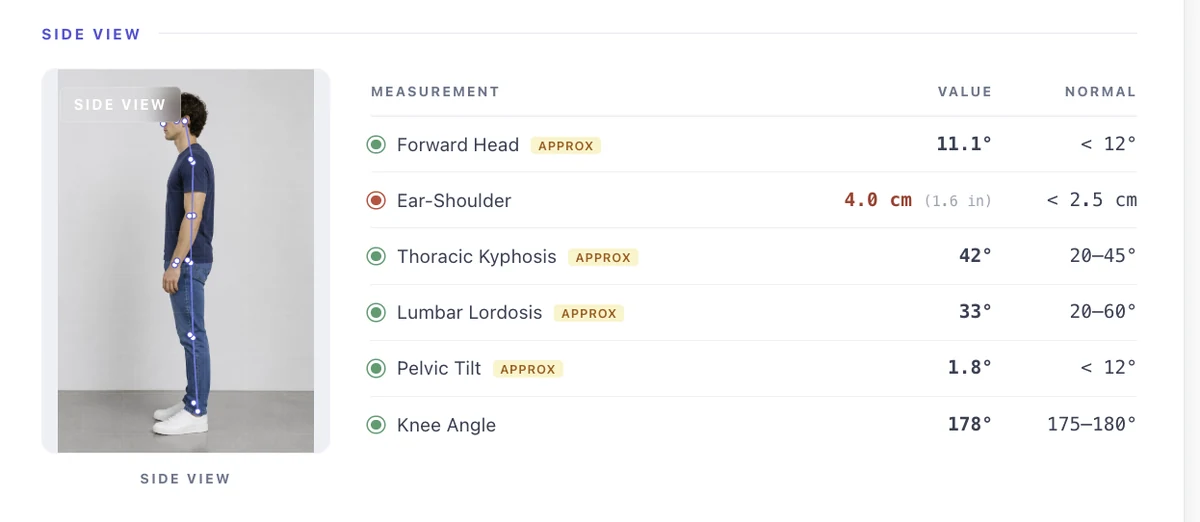
PosturaScreen, the product behind this article, finds body keypoints in a front-view and a side-view photo and computes up to 17 posture metrics from them. One photo of either view starts a report; the neck readings come from the side view. That measures external posture and can’t measure an internal spinal curve.
Around the neck, the side view gives two metrics, both shown in the sample report:
- Forward Head: the angle of the line from the shoulder keypoint to the ear keypoint, measured from vertical. It carries the
approxtag. - Ear-Shoulder: the horizontal distance in centimetres between the same two points.
PosturaScreen cannot detect military neck, for three concrete reasons:
- It’s an internal curve. Military neck is the alignment of the cervical vertebrae inside the neck. A photo sees the surface, not the spine.
- There is no keypoint for it. The keypoints PosturaScreen uses mark the ear and the shoulder. There are none on the individual neck vertebrae, so there is nothing to measure the cervical curve with.
- It’s a radiographic measurement. The cervical curve is measured on a lateral neck X-ray, a different instrument from a photograph.
PosturaScreen can measure and track forward head posture, the external pattern. Anyone who suspects military neck is better served by a clinician and, if warranted, an X-ray than by a posture photo.
When to see a clinician about military neck
A mildly reduced cervical curve with no symptoms often needs nothing. A neck curve finding, or neck symptoms that make you wonder about one, is worth a clinical visit when it comes with:
- Persistent neck pain or stiffness that does not settle with rest or keeps coming back with activity.
- Headaches that start at the back of the head or neck.
- A history of injury, particularly whiplash or another neck trauma.
- Numbness, tingling or weakness in the arms or hands. These warrant prompt evaluation whatever the neck curve looks like.
The American Academy of Orthopaedic Surgeons’ OrthoInfo guide to neck pain lists the same warning signs, including neck pain after an injury and pain that spreads into the arms with numbness or weakness. Physiotherapists, sports-medicine and primary-care physicians, chiropractors and orthopedic or spine specialists can examine the neck, take a history and order a lateral neck X-ray when it is warranted. For clinics that screen posture at intake, posture screening software for clinics can document forward head posture over time, alongside the clinical assessment of the neck curve, never in place of it.
How this article was made: the study figures come from the papers linked in the text, opened in October 2026. The description of PosturaScreen’s metrics comes from its analysis code and the published methodology; the sample report is fictional. PosturaScreen measures forward head posture but does not measure the cervical curve or detect military neck. This article is for posture education, is not medical advice and is not a substitute for a clinical evaluation. PosturaScreen is a screening and tracking tool, not a diagnostic device. See our editorial standards for how articles are written.
Free posture screening, in seconds.
Start with one photo. Add the second for all 17 metrics. No account or app required.
Start a free posture screen