Uneven Shoulders or Hips? Posture Asymmetry in Photos
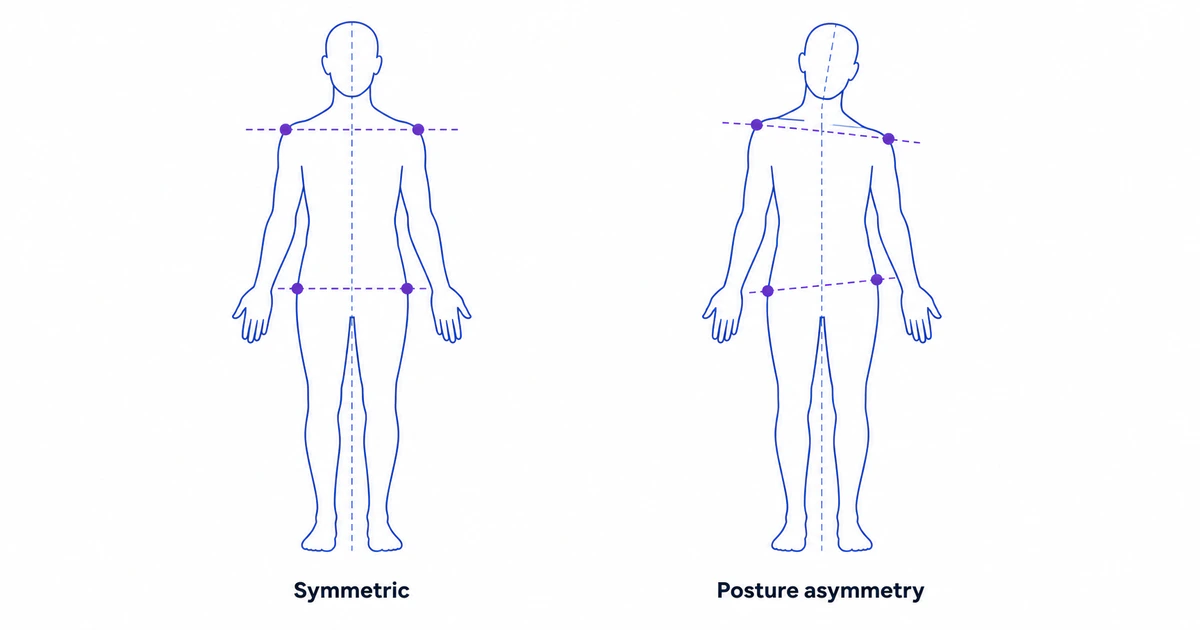
One shoulder or hip sitting a little higher than the other is common and, on its own, not a sign that anything is wrong. A 2008 study of healthy athletes notes that clinicians widely regard asymmetric shoulder posture as common, and that the dominant shoulder sits lower in most people. A front photo can measure the difference, but a phone tilted by about 2° can create one by itself (our calculation), so level the camera first.
What posture asymmetry is (and what it is not)
Posture asymmetry describes a visible difference between the left and right sides of the body when viewed from the front. The most common signs are a shoulder that sits higher on one side, a hip that rides up, a head that tilts slightly, and knees that angle differently. These are differences in the frontal plane — the side-to-side dimension you see when someone faces you directly — as opposed to the front-to-back patterns seen from the side, such as anterior pelvic tilt or tech neck.
It helps to separate three terms that often get blurred together, because they mean genuinely different things.
Posture asymmetry is a visible, geometric left-right difference that a photograph can show. It is an observation, not a diagnosis.
Muscle imbalance is a difference in strength or activation between muscles on the two sides, or between opposing muscle groups. A photograph cannot measure strength, so it cannot measure muscle imbalance. Assessing that requires functional testing or a clinical examination. The two can be related, but a visible asymmetry does not prove a strength difference, and a strength difference does not always produce a visible asymmetry.
Scoliosis is a clinical diagnosis: a sideways curvature of the spine confirmed by a healthcare professional through physical examination and imaging. A front photo cannot diagnose scoliosis. A visible asymmetry can be one screening sign among several, but the diagnosis belongs to a clinician.
| Posture asymmetryWhat a photo shows | Muscle imbalanceA strength difference | ScoliosisA clinical diagnosis | |
|---|---|---|---|
| What it is | A visible left-right difference between the two sides | A difference in strength or activation between muscles | A sideways curvature of the spine |
| How it's detected | A front-view photo of surface landmarks | Functional testing or clinical assessment | Physical examination plus imaging |
| Can a photo show it? | Yes | No | Only as one possible screening sign |
| Is it a diagnosis? | No — an observation | No — requires clinical testing | Yes — a clinician's diagnosis |
| Does PosturaScreen report it? | Yes | No | No |
Uneven shoulders — what it looks like from the front
A shoulder-height difference is the most recognizable sign of posture asymmetry, and the one people most often notice in their own photos. In a front-view image, it shows up as a tilt in the line connecting the two shoulder points: one shoulder sits higher, the other lower. A separate shoulder-region finding — a shoulder blade that lifts away from the ribcage, seen from behind rather than the front — is a winged scapula.
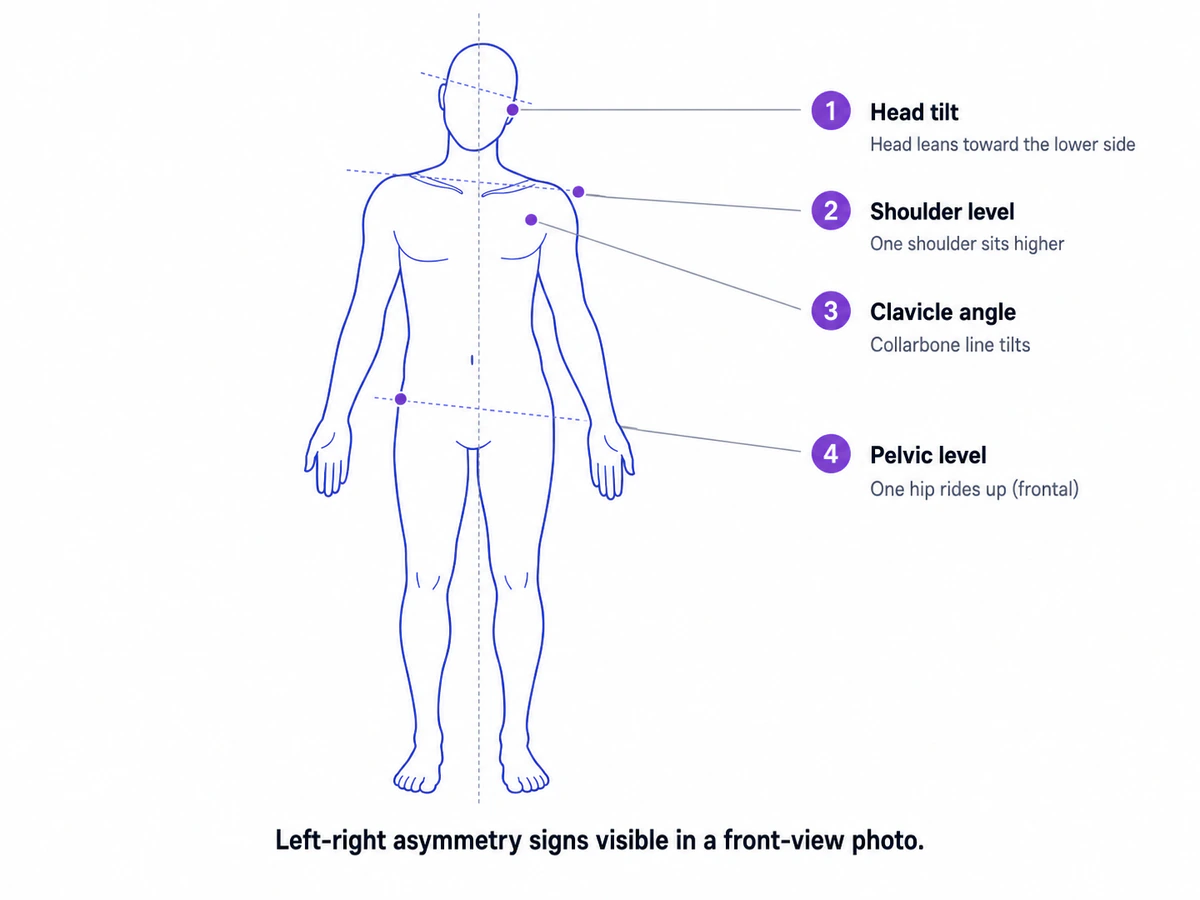
Three signs commonly travel together in the upper body. Shoulder level is the vertical difference in height between the two shoulders. Clavicle angle is the tilt of the line between the two shoulder points, so it moves with the shoulder difference. Head tilt is the tilt of the line between the eyes.
People often point to everyday habits: carrying a bag on one shoulder, sitting turned to one side at a desk, or standing with weight on one leg. These are plausible, but a photo cannot establish which one, if any, applies to a particular person. It can only show the difference.
Uneven hips and lateral pelvic tilt
The same left-right logic applies to the pelvis. When one hip rides higher than the other in a front-view photo, the line connecting the two hip points tilts — a pattern clinicians call lateral pelvic tilt, and that many people describe informally as a “hip hike.” PosturaScreen reports this as Pelvic Level, the vertical difference between the left and right hip landmarks, with a normal range under one centimeter.
It is worth being precise here, because the pelvis can be described in two completely different ways depending on the viewing plane. Lateral pelvic tilt is the frontal (side-to-side) difference seen from the front. That is different from anterior pelvic tilt — the front-to-back rotation seen from the side, covered in the anterior pelvic tilt guide. A person can have one, both, or neither. The two are measured from different photos and describe different things.
Explanations often given for a visible hip-height difference include standing with weight on one leg, habitual carrying patterns, and small natural differences in leg length; as with the shoulders, the photo cannot say which applies. Leg-length differences in particular are worth flagging to a clinician if they appear significant, because the assessment and interpretation of limb-length differences is a clinical matter rather than something a photo can settle.
Knee tracking differences (Q-angle, left vs right)
Asymmetry is not limited to shoulders and hips. The knees can track differently on the two sides, and a front-view photo can show this through the Q-angle — the angle formed by the line from the hip to the center of the knee, and from the knee to the ankle. PosturaScreen reports a Q-angle for each leg, with a typical screening range under roughly 18° for men and 22° for women.
Unlike the shoulder and hip level measurements, the Q-angle carries an approx tag. The reason is depth: estimating the hip-knee-ankle angle from a flat photo involves inferring positions that are not all at the same distance from the camera, so it is a screening estimate rather than a direct comparison of two same-depth landmarks. A difference between the left and right Q-angle is one more asymmetry signal, useful for screening and for tracking change over time rather than for clinical grading.
When knee tracking looks notably different between the two sides, or when it occurs alongside knee pain, the right step is a clinical assessment. The OrthoInfo guide to patellofemoral pain from the American Academy of Orthopaedic Surgeons covers kneecap tracking and when knee pain warrants a doctor’s evaluation.
How to take a front photo that doesn’t invent an asymmetry
Most people show a small left-right difference, so the photo has to be level enough not to add one of its own.
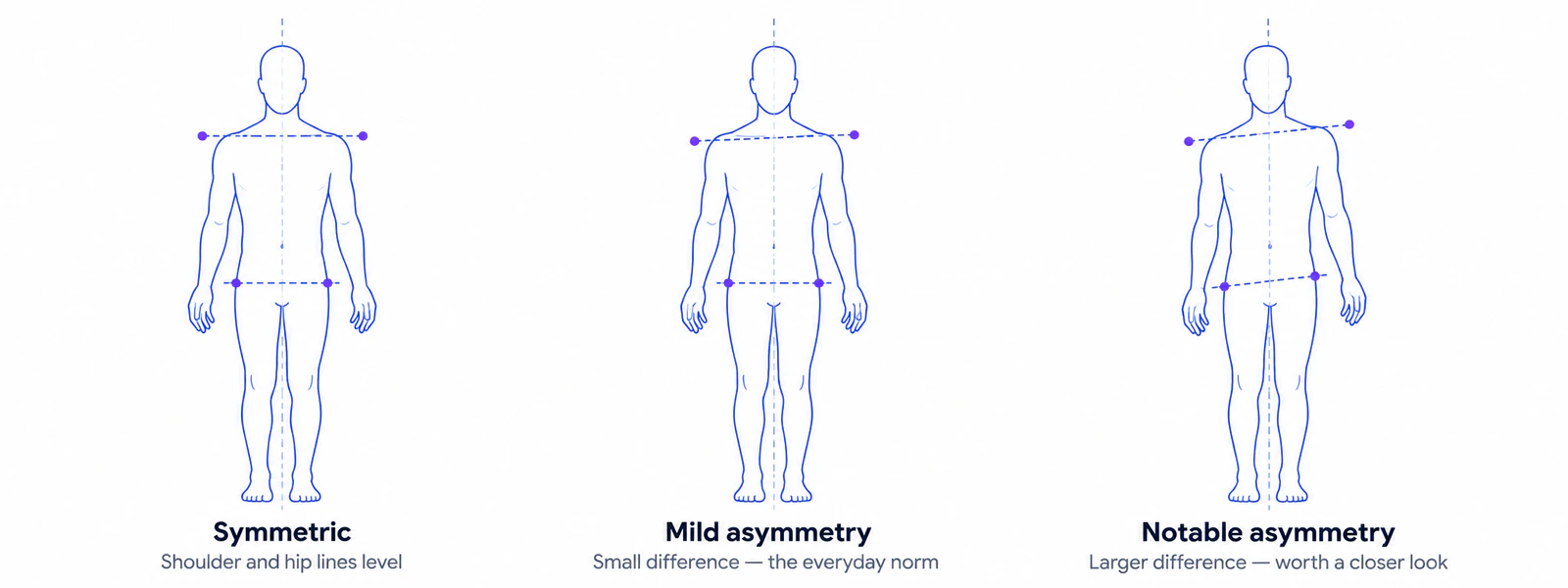
Put the camera at hip height and level, face it squarely, and stand far enough back that your body fills about two-thirds of the frame height: roughly 2 m on the 1× lens or 3 m on 2× (our estimate). Wear fitted clothing so the shoulder and hip outlines show, stand with weight even on both feet, and let your arms hang. Don’t straighten up for the shot; the point is your usual stance. The posture photo guide covers each step.
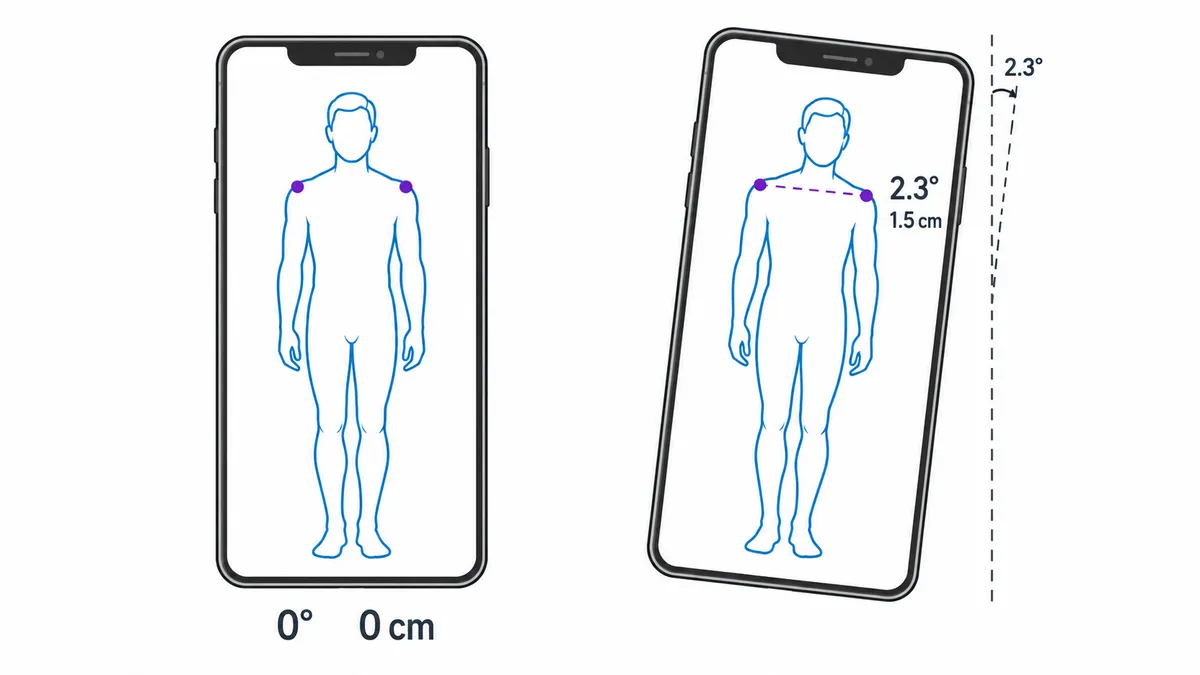
Sideways tilt matters most for this article’s measurements. By our calculation from PosturaScreen’s formulas, each degree of sideways phone tilt can shift Shoulder Level by up to about 0.66 cm, so about 2.3° of tilt alone reaches its 1.5 cm limit even when the shoulders are level. Turn on the camera grid and line a door frame up with it, or straighten the photo with the Rotate slider before running the analysis.
How PosturaScreen measures left-right asymmetry from photos
PosturaScreen, the product behind this article, computes a set of front-view symmetry metrics directly from a single front-facing photo: Head Tilt (normal under 3°), Shoulder Level (the vertical difference between the shoulders, normal under 1.5 cm), Clavicle Angle (normal under 5°), Pelvic Level (the frontal hip-height difference, normal under 1 cm), and Q Angle for each leg (a screening range under roughly 18° for men and 22° for women). Shoulder Level and Pelvic Level also note which side is higher, in your own left and right rather than the mirror image.
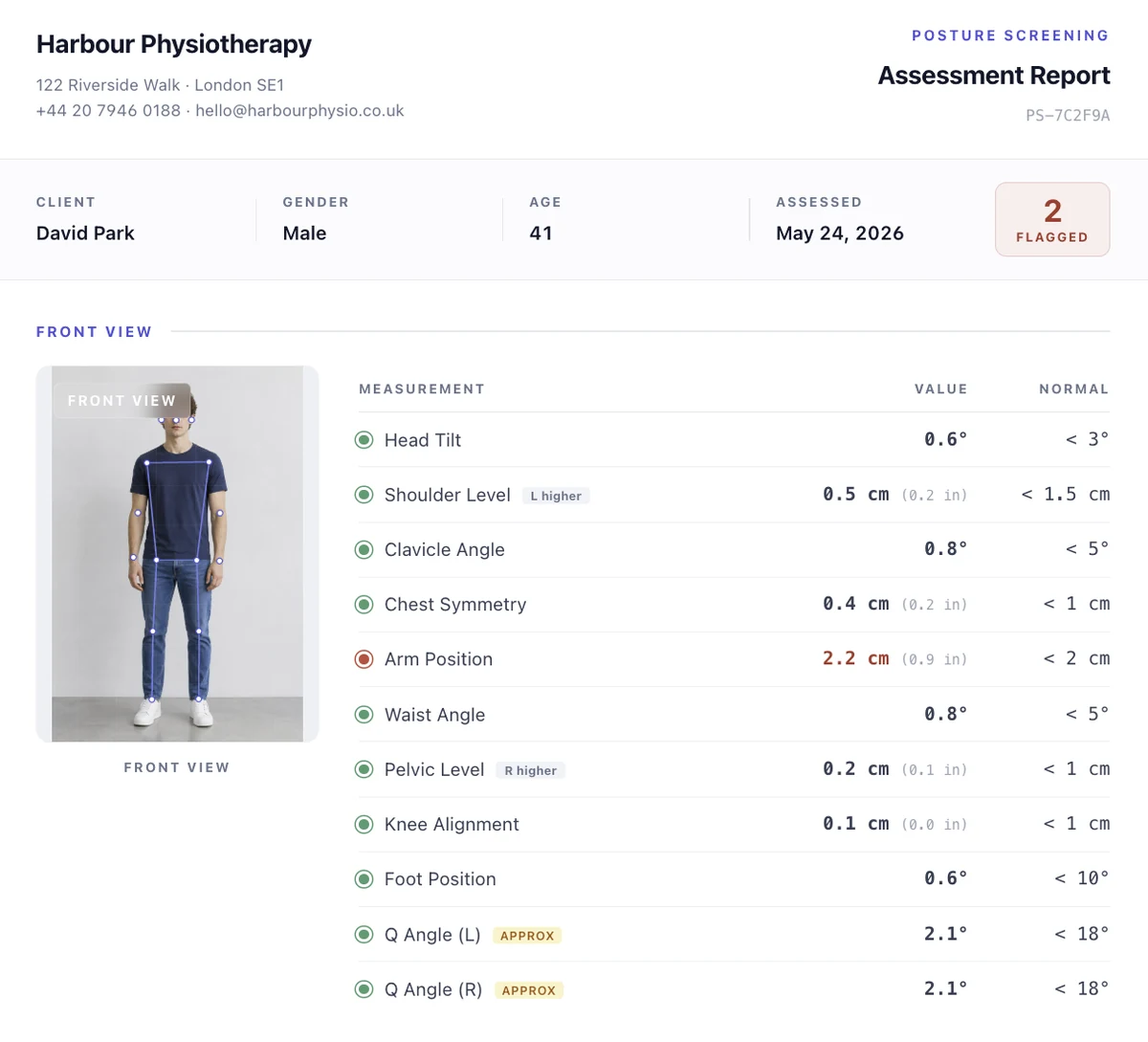
approx.Most of these front-view symmetry metrics are not tagged approx. Comparing two landmarks at roughly the same depth, such as the left shoulder height against the right, is more directly measurable from a 2D photo than estimating a spine curve, which has to infer depth. The Q-angle remains approx because it involves that depth inference.
The practical value of these numbers is tracking. A shoulder-level difference of 1.8 cm today is most useful when compared with the same person’s reading six weeks later, taken with the same camera setup, after a change in habits like switching the bag-carrying side or adjusting a workstation. A comparison shows whether each value increased, decreased or stayed the same. Stance and camera setup also move the numbers, so a difference between two photos is not, by itself, evidence that the body changed. The full definition of each metric is on the methodology page, and the sample report shows a complete front-view readout.
PosturaScreen reports the visible left-right differences in a photo. It does not assess muscle strength or activation, and it does not diagnose scoliosis or any spinal condition. It is a screening and tracking tool, not a diagnostic device. Practitioners who want to run this same front-view screening in their own practice can do so with posture screening software for clinics.
When uneven shoulders or hips need a clinician
A small, stable difference with no symptoms needs nothing more than a level photo now and then. It is worth consulting a licensed physiotherapist, physician, or chiropractor when an asymmetry is notable, new, or progressing; when it occurs alongside pain, stiffness, or restricted movement; or when there is any numbness, tingling, or weakness, which warrant prompt evaluation regardless of posture.
One situation deserves particular attention: a new or progressing asymmetry in a child or adolescent. Scoliosis screening in young people is a routine clinical matter, and a visible asymmetry in that age group is best evaluated by a healthcare professional rather than interpreted from a photo. The Cleveland Clinic overview of scoliosis lists uneven shoulders among the signs and explains when to see a provider.
How this article was made: the tilt figures are our calculation from PosturaScreen’s published formulas, explained in the posture photo guide, not a measurement on people. This article was prepared by the PosturaScreen editorial team for posture education. It is not medical advice and is not a substitute for a clinical evaluation. PosturaScreen is a screening and tracking tool, not a diagnostic device. If you have concerns about your posture or musculoskeletal health, consult a licensed healthcare professional. See our editorial standards for how this article was written and reviewed.
Free posture screening, in seconds.
Start with one photo. Add the second for all 17 metrics. No account or app required.
Start a free posture screen