How Accurate Is Photo-Based Posture Analysis?
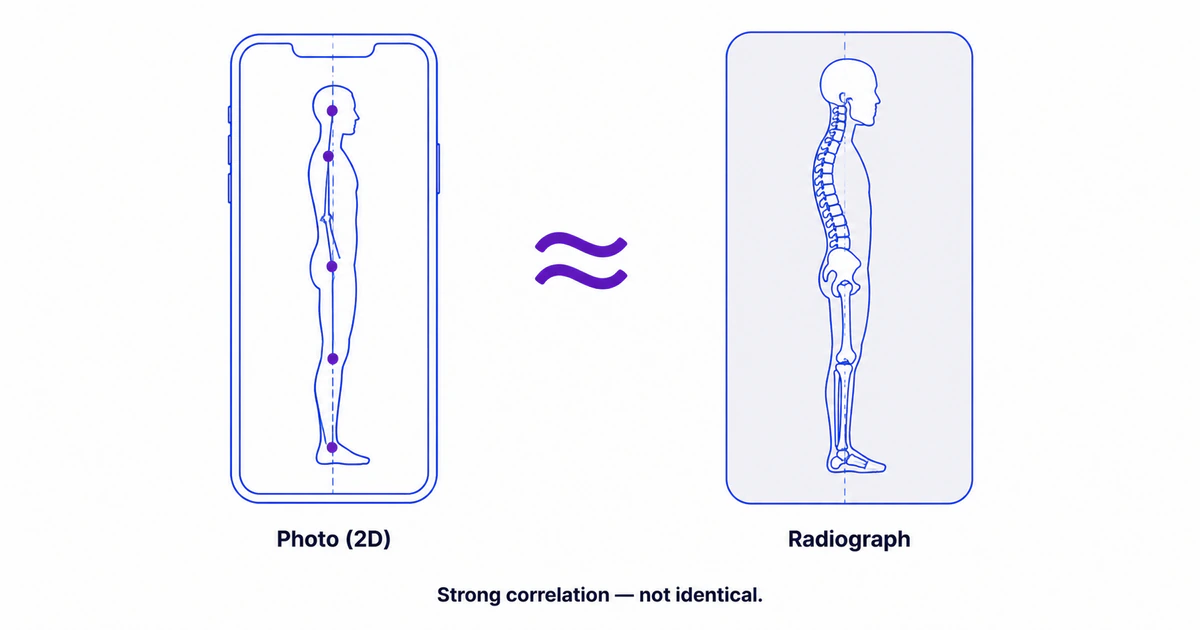
Photo-based posture analysis is accurate enough for what it’s designed to do — screening and tracking change over time — but it is not a substitute for radiographic measurement, and the honest answer depends on two separate questions. Reliability (does the same posture give the same number?) is strong: peer-reviewed studies report high repeatability for photographic postural angles. Validity (does the number match a gold-standard measure?) is good but not perfect: AI 2D estimates correlate strongly with X-ray measures without being identical. This guide explains what the research found, why reliability matters more than absolute accuracy for tracking, and where the real limits are.
- “Accurate” splits into two questions: reliability (repeatable?) and validity (matches gold standard?). They’re not the same.
- Reliability is strong — studies report inter-rater ICCs above 0.97 and ICCs around 0.98 for photographic and photogrammetric postural angles.
- Validity is good, not perfect — AI 2D estimates correlate strongly with radiographic measures (e.g., forward-head vs. craniovertebral angle) but aren’t identical.
- For tracking change in the same person, high reliability is what matters — and it’s the strongest part of photo-based analysis.
- A photo is not an X-ray. It measures surface landmarks, so curve and 3D-angle estimates are screening estimates, tagged honestly — not radiographic values.
“Accurate” actually means two different things
When people ask whether a posture app is “accurate,” they’re usually asking two questions at once without realizing it — and the two have different answers.
The first is reliability: if you measure the same posture twice, do you get the same number? This is about consistency, or repeatability. The second is validity: does that number match what a gold-standard tool — an X-ray, say — would report? This is about trueness. A bathroom scale that always reads two kilograms heavy is perfectly reliable (consistent every time) but not valid (consistently wrong). The two properties are independent, and conflating them is the source of most confusion about whether photo-based posture analysis “works.”
The distinction matters because the two properties serve different jobs. If the goal is to assign someone an absolute, clinical-grade number, validity is everything. But if the goal is to track whether a person’s posture is changing over time — which is the primary job of a screening tool — then reliability is what carries the weight. A measure that’s highly repeatable will show a real change as a real change, even if its absolute value is a few degrees off a radiograph. The rest of this article looks at what the research found on each property in turn.
What the research says about reliability
Reliability is the stronger of the two for photo-based posture measurement, and the evidence is consistent.
A 2015 study of photographic posture analysis in adolescents reported inter-rater reliability above 0.97 and test-retest reliability above 0.77 across the postural angles it measured (Hazar et al., 2015, Journal of Physical Therapy Science). A 2025 study of photogrammetric evaluation found even higher agreement — intraclass correlation coefficients around 0.98 for both inter- and intra-examiner reliability across craniovertebral angle, swayback posture, and knee hyperextension (Mylonas et al., 2025, Journal of Physical Therapy Science).
Those numbers need a plain-language translation. The ICC (intraclass correlation coefficient) runs from 0 to 1, where 1.0 is perfect agreement. By the usual convention, above 0.9 is “excellent” and 0.75 to 0.9 is “good.” So an inter-rater ICC of 0.97 means two different people measuring the same photo land on nearly the same number — the method isn’t introducing much noise of its own. That consistency is exactly what makes a measure trustworthy for tracking, and it’s why a photo taken under the same conditions a few weeks apart can be compared with confidence. PosturaScreen leans on this property directly: how each metric is computed is a fixed geometric calculation, so the same keypoints always produce the same value.
What the research says about validity (vs X-ray)
Validity — agreement with a gold standard — is where the honest answer is “good, but not identical.”
The most directly relevant evidence comes from a 2025 study of AI-based 2D posture-estimation software measured against radiographic imaging. It found strong correlations between the software’s photo-derived measures and the X-ray measures: the forward-head measure correlated with the craniovertebral angle at r = −0.71, and a hip-knee-ankle alignment measure correlated with its radiographic equivalent at r = 0.75, with inter-rater reliability of 0.84 for cervical and 0.90 for lower-limb assessments (Park et al., 2025, Diagnostics).
In plain terms, a correlation around 0.7 to 0.75 is strong: when the photo measure goes up, the X-ray measure reliably goes up too. But a strong correlation is not the same as identity. The photo number and the radiograph number move together; they are not the same number. That gap is not a flaw to hide — it’s the honest reality of measuring a three-dimensional body from a flat image, and it’s precisely why the metrics that stand in for a radiographic angle or a spinal curve are reported as screening estimates and tagged approx. The approx tag and what it means is the product being upfront about exactly this distinction.
Why a photo isn’t an X-ray (the honest limits)
The reason validity tops out at “strong but not identical” comes down to what a photo can and can’t see.
A photo measures surface contour — the outline of the body and the position of visible landmarks. An X-ray measures bone. Between the skin and the skeleton sit clothing, soft tissue, and body composition, all of which shift the surface relative to the underlying structure. On top of that, a single photo is a 2D projection of a 3D body, so any small rotation of the person relative to the camera nudges the apparent angle. Breathing phase and the exact moment of capture add a little more variation. None of these affect a radiograph, which is why it remains the gold standard.
This is also why five of the metric types — forward head, thoracic kyphosis, lumbar lordosis, pelvic tilt, and the Q-angle — carry the approx tag: each estimates a 3D angle or a spinal curve from a flat image. And a photo captures a single moment, not continuous data, which is a different limitation that wearable sensors address — covered in the comparison of photo-based versus sensor-based methods. Knowing these boundaries is what lets the numbers be used correctly rather than over-trusted.
What this means for using photo-based screening
Put the two findings together and a clear use-case falls out.
For tracking change in the same person over time, photo-based analysis is on solid ground: reliability is high, so a change across matched photos is a real change, not measurement noise. This is the job it’s built for. For absolute clinical grading, comparing one person’s numbers against another’s, or diagnosis, it’s the wrong tool — those need a clinician’s examination and, where appropriate, imaging. The best practice follows directly: capture under consistent conditions and read the trend, not a single absolute value.
That’s exactly how PosturaScreen is positioned. It computes 17 measurable metrics from two photos, tags the estimates honestly, and is built for screening and tracking — not diagnosis. The sample report shows what that looks like in practice, and for practices, the same engine underpins posture analysis software for practitioners. The evidence supports using it for what it’s good at, and the honest limits keep it in its lane: a screening and tracking tool, not a diagnostic device, and not a replacement for clinical examination. The information here is educational, not medical advice.
Frequently asked questions
How accurate is photo-based posture analysis?
It’s accurate enough for screening and tracking change over time, but it isn’t a substitute for an X-ray. “Accurate” has two parts: reliability (does the same posture give the same number?) and validity (does the number match a gold standard?). Reliability is strong — studies report inter-rater agreement above 0.97 for photographic postural angles. Validity is good but not perfect — AI 2D estimates correlate strongly with radiographic measures without being identical.
What’s the difference between reliability and validity?
Reliability is repeatability: take the same posture twice and get the same number. Validity is trueness: does the number match a gold-standard measure like an X-ray. A method can be highly reliable without being perfectly valid. For tracking change in the same person over time, reliability matters most — and it’s the strongest part of photo-based posture analysis.
Is a posture app as accurate as an X-ray?
No, and it isn’t meant to be. A photo measures surface landmarks; an X-ray measures bone. Research shows AI 2D posture estimates correlate strongly with radiographic measures, but they aren’t identical, because surface contour is influenced by clothing, body composition, and body rotation relative to the camera. That’s why spinal-curve and 3D-angle estimates are reported as screening estimates, tagged approx.
What do the ICC numbers in posture studies mean?
ICC (intraclass correlation coefficient) measures agreement on a 0-to-1 scale: 1.0 is perfect agreement, above 0.9 is usually called excellent, and 0.75-0.9 is good. When a study reports an inter-rater ICC of 0.97 for a photographic posture angle, it means two raters measuring the same photo land on nearly the same number — strong reliability.
Can photo-based posture analysis track change accurately?
Yes — this is its strongest use case. Because reliability is high, the same person measured under consistent conditions will get comparable numbers, so a real change over weeks shows up as a real change in the metric rather than as measurement noise. Tracking change is more robust to small absolute-value uncertainty than comparing one person’s absolute numbers to another’s.
Should clinicians trust photo-based posture screening?
As a screening and tracking tool, yes, used appropriately. The reliability and correlation-with-radiograph evidence supports using it to flag patterns and track change, while the honest limits (it’s not an X-ray, the estimates are tagged approx) keep it in its lane. It’s designed to support clinical judgment, not replace examination or imaging.
This article was prepared by the PosturaScreen editorial team for posture education. It is not medical advice and is not a substitute for a clinical evaluation. PosturaScreen is a screening and tracking tool, not a diagnostic device. See our editorial standards for how this article was written and reviewed.
Free posture screening, in seconds.
Start with one photo. Add the second for all 17 metrics. No account or app required.
Start a free posture screen