Photo vs Sensor Posture Analysis: How They Compare
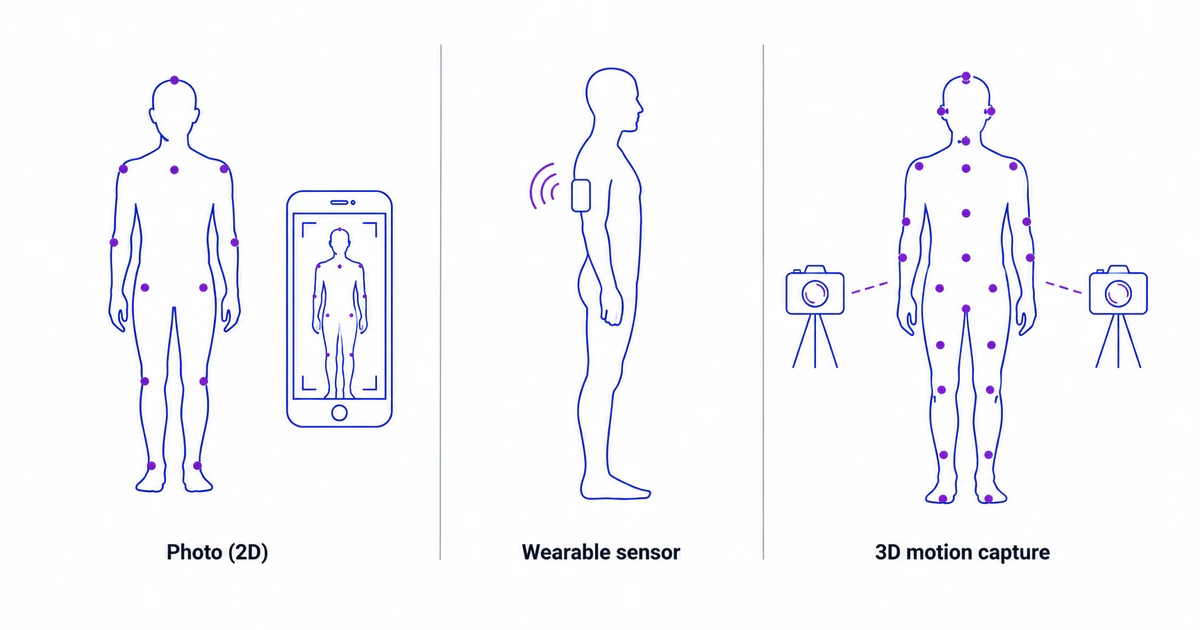
Posture can be analyzed three main ways today: from photos (2D computer vision), from wearable sensors (accelerometers and inertial units worn on the body), and from 3D motion capture (lab-based marker systems). Each makes a different trade-off. Photo-based analysis is accessible and well-suited to screening and tracking change over time; wearable sensors are built for real-time feedback and continuous monitoring; 3D motion capture is the research-grade standard but needs a lab. This guide explains how each works, what it measures well, where it falls short, and which approach fits which goal — without recommending any specific device.
- Three main paradigms: photo (2D vision), wearable sensor, and 3D motion capture — plus subjective visual checks.
- Photo starts with one or two images: each view supplies its own metrics, and front plus side completes the whole-body 17-metric screen.
- Wearable sensors give real-time feedback and continuous monitoring, but typically track one region and need the device worn.
- 3D motion capture is the precision standard but is lab-only — cost, space, and expertise put it out of reach for everyday screening.
- The “best” method depends on the goal: screening & tracking vs. real-time correction vs. research-grade kinematics. No single method wins everything.
The three methods at a glance
| Photo (2D)Computer vision | Wearable sensorWorn IMU | 3D motion captureLab markers | |
|---|---|---|---|
| What it measures | Whole-body geometry from landmarks | Movement and angle of one region | Full 3D joint kinematics |
| Hardware needed | A phone camera | A worn device | Lab cameras + markers |
| Cost & access | Free to low, runs in a browser | Device purchase | High; specialist lab |
| Real-time? | No — a snapshot | Yes — continuous | Yes — in a lab session |
| Best for | Screening & tracking over time | Real-time feedback & habit cues | Research-grade measurement |
| Main limit | Single moment; surface contour | Region-specific; needs wearing | Not portable; expensive |
The main ways to analyze posture today
Before comparing technologies, it helps to separate the goal from the method. Someone might want a quick informal check, an objective baseline they can repeat, a buzz on their wrist when they slouch, or research-grade joint angles. Different goals point to different methods.
Four approaches cover almost everything in use today. Subjective visual assessment — a trained eye noting “the shoulders look rounded” — is fast and free but hard to repeat between sessions. Photo-based 2D analysis uses computer vision to turn photos into measured geometry. Wearable sensors attach an inertial unit to the body and stream movement data. 3D motion capture uses multiple cameras and markers to reconstruct full three-dimensional motion. The rest of this guide looks at the three instrumented methods, since the subjective check, while useful, isn’t measurement.
Photo-based posture analysis
Photo-based analysis starts from one or two photos — typically a front and a side view. A pose-estimation model locates anatomical keypoints (shoulders, hips, knees, ankles, and so on), and deterministic geometric formulas convert those keypoints into angles and offsets: the posture metrics. There’s no per-user black box; the same keypoints always produce the same values. How PosturaScreen computes each metric documents this in full.
Its strengths are accessibility and breadth. A phone is the only hardware and the analysis runs in a browser. One view returns the metrics visible from that angle; front and side together produce the complete 17-metric readout across the head, shoulders, spine, pelvis, and knees. Because the output is a fixed geometric calculation, it’s repeatable enough to track change over weeks, which is the primary screening use case. On validity, a 2025 study of AI-based 2D posture software found strong correlations with radiographic measures — forward-head angle against the craniovertebral angle, and the hip-knee-ankle angle against its radiographic equivalent — while remaining distinct from them (Park et al., 2025, Diagnostics). We unpack what that evidence does and doesn’t show in how accurate photo-based posture analysis is.
Its limits are equally clear. A photo is a single moment, not continuous data, so it can’t catch posture drifting over a workday. And it measures surface contour, not bone, so spinal-curve and 3D-angle estimates are screening estimates rather than radiographic values. That honesty is built into the report as an approx tag — you can see how it reads in a sample report. Photo-based analysis is also the basis for posture analysis software for practitioners, where the repeatable, report-ready output fits inside an appointment.
Wearable and sensor-based posture tracking
Wearable approaches attach a small inertial measurement unit — an accelerometer and gyroscope — to the body, often on the upper back or the back of the neck. The sensor measures the tilt and movement of that region and can vibrate when posture drifts past a threshold, giving the wearer a real-time nudge. Research supports the use of inertial units for posture monitoring when they are properly calibrated (Scientific Reports, 2021 — “Evaluation of head posture using an inertial measurement unit”).
The strength of this approach is what photos can’t do: continuous, real-time feedback. For someone actively trying to build a posture habit, an in-the-moment cue is more actionable than a periodic report. The sensor works while you go about your day, not just when you stop to take a photo.
The trade-offs are the mirror image of photo analysis. A single worn sensor usually tracks one region rather than whole-body geometry, so it answers “is my upper back slouching right now” more than “how does my whole posture compare to last month.” It depends on the device being worn and charged, and it generally doesn’t produce a multi-metric report a client can take home. Wearables and photo screening aren’t really competitors — they serve different moments: continuous correction versus periodic assessment.
3D motion capture
Three-dimensional motion capture is the precision benchmark. Multiple synchronized cameras track reflective markers placed on the body to reconstruct full three-dimensional joint positions and movement. For research into how the body actually moves, it’s the closest thing to ground truth outside of imaging.
That precision comes at a cost that rules it out for everyday use. It needs a dedicated lab, a marker set applied by trained staff, specialist software, and time — none of which fits a routine appointment or a self-check at home. In practice, 3D motion capture serves as the reference standard that other methods are validated against, rather than as a tool people reach for to screen and track posture day to day.
Which approach fits which goal
The clearest way to choose is to start from the goal, not the technology.
For screening and tracking change over time, photo-based analysis is usually the practical fit: accessible, repeatable, whole-body, and report-ready. For real-time correction and habit-building, a wearable sensor’s in-the-moment feedback is the better tool. For research-grade kinematics, 3D motion capture remains the standard. And for a quick informal check, the trained eye still has a place — though it can’t be repeated reliably enough to prove change.
None of these is universally best. A person building a habit might wear a sensor day-to-day and use a photo screen every few weeks to track the bigger picture; the two complement rather than replace each other.
Where PosturaScreen fits
PosturaScreen is a photo-based system built for screening and tracking. A single front or side photo produces the metrics for that view; together they complete all 17 whole-body metrics. A private one-off screen needs no account, while registration is reserved for saved history and professional workflows. The sample report shows the full two-view output.
It is deliberately not a real-time monitor, and it is not a diagnostic device. It does not buzz when you slouch, and it does not replace a clinician’s examination or a radiograph. What it does well is turn one or two photos into an objective, repeatable readout — with both views completing the whole-body picture. For continuous correction, a wearable is the right tool; for periodic, objective assessment, photo-based screening is hard to beat on accessibility.
Frequently asked questions
What’s the most accurate way to measure posture?
For absolute precision, 3D motion capture and radiographic imaging are the reference standards, but both require a clinic or lab. For accessible, repeatable measurement, photo-based analysis and wearable sensors are both well-supported — they trade some absolute precision for convenience. The most accurate method depends on the goal: research-grade kinematics, real-time feedback, or screening and tracking over time.
Are wearable posture devices better than photo-based apps?
They are built for different jobs. Wearable sensors excel at real-time feedback and continuous monitoring of one body region. Photo-based analysis captures whole-body geometry across many metrics in a single screen and suits tracking change over weeks. Neither is universally better; one is for in-the-moment correction, the other for periodic assessment.
How does photo-based posture analysis work?
A pose-estimation model locates anatomical keypoints in a front and side photo, then deterministic geometric formulas turn those keypoints into angles and offsets — the posture metrics. There is no per-user black box; the same keypoints always produce the same values.
Can a photo really measure posture accurately?
A photo reliably measures surface-landmark geometry, and studies report strong reliability for photographic postural angles and strong correlation between AI 2D estimates and radiographic measures, though not identity. Estimates that stand in for a 3D angle or spinal curve are tagged as screening estimates. Photo readings are best for tracking change in the same person over time.
Do I need special hardware to analyze my posture?
Not for photo-based analysis — a phone camera is enough and the analysis runs in a browser. Wearable approaches require buying and wearing a device; 3D motion capture requires a lab. That accessibility difference is the main reason photo-based screening has become common.
Which posture analysis method is right for a clinic?
For a practice that wants an objective, repeatable assessment that fits inside an appointment and produces a client-facing report, photo-based screening is usually the practical fit — no hardware, fast, easy to repeat. Real-time wearables suit habit coaching; motion capture suits research. Many practices use photo-based screening for assessment.
This article was prepared by the PosturaScreen editorial team for posture education. It is not medical advice and is not a substitute for a clinical evaluation. PosturaScreen is a screening and tracking tool, not a diagnostic device. Product comparisons are general and do not constitute an endorsement of any specific device. See our editorial standards for how this article was written and reviewed.
Free posture screening, in seconds.
Start with one photo. Add the second for all 17 metrics. No account or app required.
Start a free posture screen